Essential Information - Everest Base Camp Trek by road
Benefits of Booking Everest Base Camp Trek by road with Vertex Holiday
- Expert Guidance: Vertex Holiday’s experienced English-speaking local guides who are trained in first aid and altitude sickness management, ensuring safety and enriching the cultural experience.
- Logistical Support: Vertex Holiday arrange all necessary permits, comfortable transportation, food, accommodation bookings, and porter services, significantly reducing planning stress.
- Acclimatization Planning: Vertex Holiday design itineraries with carefully planned ascent rates and built-in acclimatization days, maximizing the chances of a successful and safe trek.
- 24 Hours Company Assist: Vertex Holiday Team member will assist during the trip.
- Airport pick up & Drop Service: Vertex Holiday will provide personal Airport drop and pick up any time.
- Customize Trip Facility: During the trip some reason cannot get right place that time company and staff help you customize trip.
- Nepali Sim Card: After arrival in Nepal , vertex Holiday provide per person 1 Ncell sim card with 20 GB Data for easy connection
- Free luggage store at Vertex Holiday office Store in Thamel
The Best Seasons For Everest Base Camp Trek By Road Journey In Nepal:
The best times for the Everest Base Camp Trek by road are spring and autumn/fall. Spring begins in March and ends in May, and autumn begins in September and ends in November.
Everest Base Camp Trek by road springtime, with longer sunshine hours, is one of the best seasons for drives, treks, and various adventures. As well as for stunning views of the Himalayan Mountain ranges, cold mornings, within the shade, and at night. Late afternoon can get overcast with light rain and snowfall sometimes.
Autumn begins in September and ends in November, one of the best times for trekking to Everest and other Himalayan regions. During autumn, most days are clear, for clear views and exciting walks. But with shorter sunshine hours. It gets dark by 5 p.m. Most days are bright with sunshine, except for snowfall sometimes above 2,500 m. Cold mornings, and in the shade, nights, but with clear, starry nights.
Interested trekkers can enjoy the trek during the wintertime from December to February. Despite the cold and freezing morning and night temperatures, most days are crystal clear with sunshine. Days are short due to limited sunlight hours, and the sunrise is from late 6 a.m. onward till sunset at 5 p.m. needs to cover the distance before darkness falls, the best winter trekking is when encountering fewer groups of trekkers.
Why Choose 15 Days Everest Base Camp Trek By Road :
Everest Base Camp Trek by road is the best option. In comparison with a short flight to Lukla Tenzing & Hillary Airport in and out from Kathmandu or Ramechap airport. Choosing the options with the itinerary set by Vertex Holiday allows travelers to enjoy the trek. Than taking a flight from Kathmandu to Lukla and vice versa. The Himalayan weather can be unpredictable for the Lukla flight and vice versa to Kathmandu. In this situation, due to the bad weather conditions, the passengers have to wait anxiously for a clear and fine day. The overland journey to Surkhe and back to Kathmandu can be a long drive. Some trekkers might get inconvenienced by the drives on rugged mountainous roads. But, on the other hand, trekkers will have the great opportunity to witness and experience more of Nepal’s rural village life. Visitors will find a great contrast between the two routes. From the isolated places of Solu to the mainstream of Khumbu with a crowd of trekkers. Choosing the Everest base camp via an overland makes you feel the difference in the landscapes. Includes the culture of the mixed group of different tribes of Solu and the dominant Sherpa of Khumbu.
Travel & Medical Insurance Requirement For Everest Base Camp Trek By Road Trip:
Everest Base Camp Trek by road trip Travel and Medical Insurance is mandatory, and important, especially around a high Himalayan country in Nepal. Travel Insurance in case of unfavorable weather conditions. Sometimes the trek and driving routes might lead to delays or rerouting, due to landslides, avalanches, and broken trails.
If an unexpected situation arises beyond the company’s control, which rarely happens, the guide will keep you informed. In these unfortunate conditions, Travel Insurance plays a vital role in reimbursement. The extra expenses incurred due to the above cause and situations.
Medical Insurance applies if someone gets very sick due to various illnesses, like AMS (Acute Mountain Sickness).
For a patient with severe illness or an unfortunate accident, it requires a fastest means of evacuation. Using the service of a Helicopter to bring the patient to Kathmandu for medical treatment. The patient’s extra expenses, the medical bills, private transportation, or the use of helicopter services. Needs to be claimed from one’s Medical Insurance for all expenses incurred.
Accommodation En Route Everest Base Camp Trek by road trip:
Everest Base Camp Trek by road trip, Trekkers will be surprised to find the standard of lodge accommodation en route to Everest Base Camp. Starting and ending the treks at Surkhe, trekkers can enjoy the nice lodge accommodation throughout the treks and drives.
From Salleri to Surkhe, accommodations are in simple lodges with a common toilet and bath. As the trek reaches the main trail to Phakding, the Khumbu area offers the best standard lodge accommodation. From moderate to Luxury deluxe lodge accommodations, with attached baths and toilets.
After Namche Bazaar and Phortse, with Gorakshep, these lodges provide common baths and toilets. This is due to the harsh terrain and the pipeline and plumbing systems freeze with the cold temperatures in the morning, late afternoon,
and nights. Dining rooms are nice, cozy, with hot pot-bellied stoves to keep the environment warm while you enjoy meals.
Food En Route En Route Everest Base Camp Trek by road trip:
All lodges offer a food menu, breakfast, oats, porridge, and cornflakes. Bread, Chapatti, Pancakes with choices of eggs from scrambled, boiled, poached, and omelets. Followed by warm, refreshing drinks, tea, coffee, and drinking chocolates
Lunch and dinner offer continental, Indian, Nepali, Chinese, and Tibetan or Sherpa food. Some lodge restaurants also offer Mexican, Italian, Japanese, and Korean food, as well as fresh bakery items. All dining rooms are bright with lamps,
which operate by local hydroelectricity or solar power. Some lodges also provide free internet or Wi-Fi, but it will be quite slow. This is due to landscapes and weather conditions at designated overnight stops.
For large groups of more than four people, it is best to order a set meal, as it saves time and fuel. It is good to follow the norms of Eco and Responsible Tourism.
Fitness Reqiured For Everest Base Camp Trek by road trip:
Everest Base Camp Trek by road, All trekkers should be physically fit and in sound health. For trekkers with medical history and special dietary requirements, clients
should inform the company upon booking. So, the company and guide will make the necessary arrangements regarding one’s health and diet. A minimum age of 14 to a maximum of 70 years old can join this adventurous journey. Under 16 and above 70 years of age must be accompanied by a guardian or close friend. To stay physically fit, practice exercise, like walking, jogging, or any other good physical activity. It is best to check with your doctor before booking the trip for the Everest base camp trek by road.
Permits Required For Everest Base Camp Trek By Road Trip Package:
The Trekking Permits Requirements for all trekking regions around the Nepal Himalayas. For Everest, the Solu-Khumbu district village community will issue the permit for each trekker. The permits is obtained by the guide after producing your passport details, passport-sized photos, and the duration of the trek. Includes Sagarmatha National Park entrance tickets, which will be purchased by the guide as per the booking policy.
Acclimatization On Everest Base Camp Trek By Road Trip
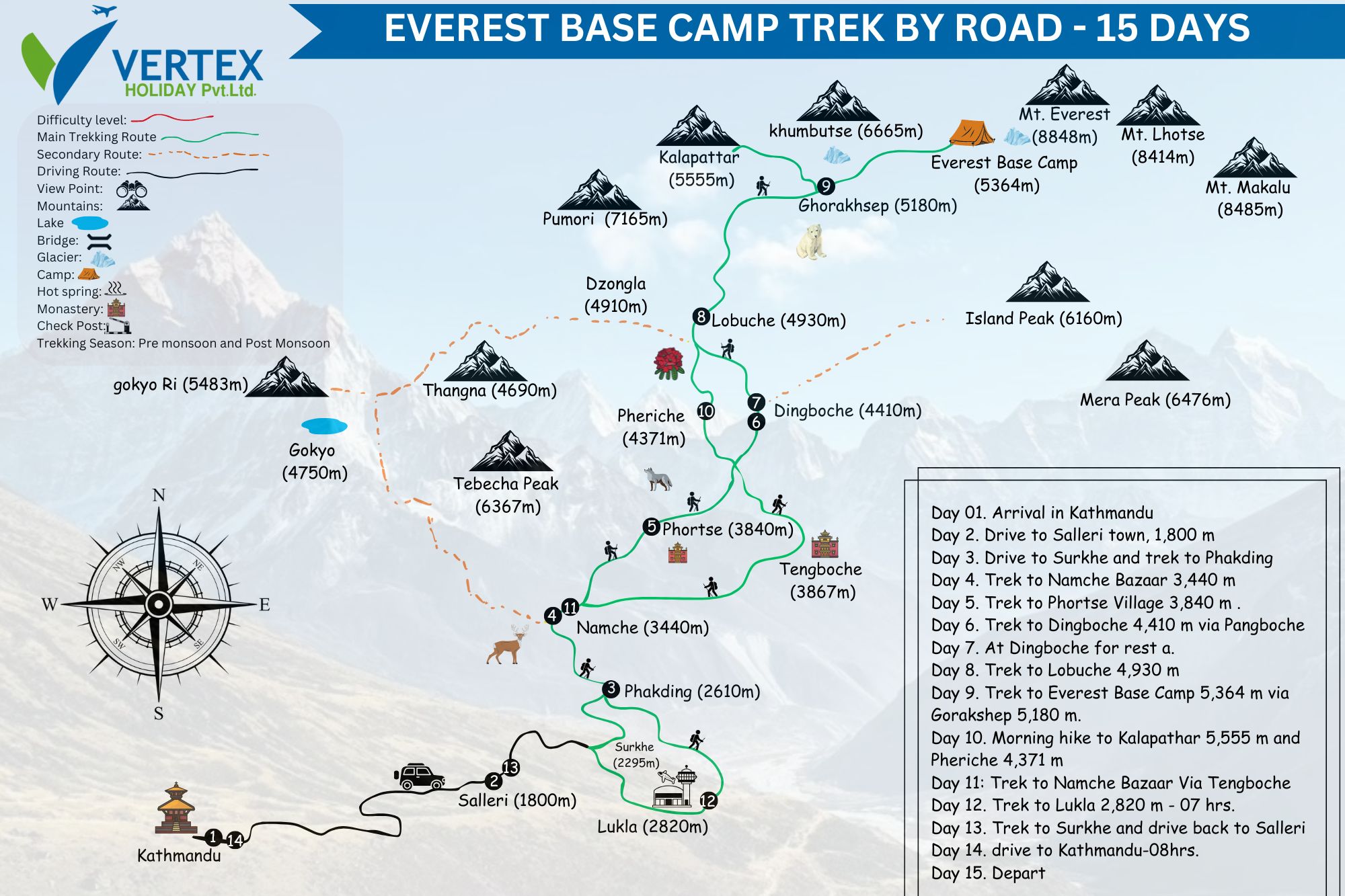
Starting the journey from Kathmandu at 1,340 m high, reaching Salleri Town at 1,800 m high. Then reach Surkhe 2,295 m and start the trek to Phakding at 2,657 m. Reaching 3,440 m at Namche Bazaar, it allows trekkers to acclimate to the altitude and its high terrains.
Furthermore, the itinerary has a rest day in Dingboche at the height of 4,410 meters. An extra day in Dingboche, acclimatization hike to Nagkartshang high ridge at 5,121 m /16,798 feet. It will be a great support to get acclimatized before heading towards Everest Base Camp and climbing to Kalapathar.
As long as all is fit and able, trekkers will slowly acclimate, including overnight stops at certain heights. Taking it slow with enough rest in between the walks will be the best, and drinking more fluids, water, or tea. It keeps trekkers fit
from dehydration, which is important on high-altitude walks.
Difficulties And Physical Fitness Required for Everest Base Camp Trek By Road Trip
On the Everest Base Camp Trek by road trip, as mentioned above, all participants need to be physically fit and in good health. The difficulties that some people might experience are the long drive to Salleri and back to Kathmandu.
Apart from the long drive, once you start the trek, the difficulties of the long drive will be forgotten. As the walk progresses, trekkers will enjoy the scenic views of towering peaks and in the harmony of local colorful cultures. Taking it slow and steady with a few rests, eating and sleeping well will support you against all odds and difficulties.
Extension Options After Everest Base Camp Trek By Road Trip
The Solu and Khumbu areas of Everest are one of the most picturesque regions around the Himalayas, probably in the world. Besides, the Everest base camp treks. Trekkers with time in Nepal can enjoy the walk to beautiful Gokyo.
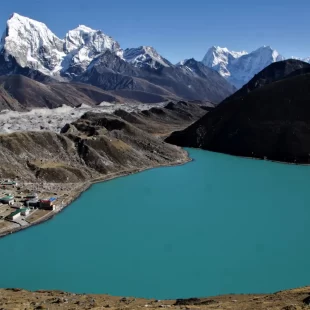
A scenic Gokyo Valley with a glacial, emerald colored lake, trekkers can also enjoy the Everest three passes Trek. Crossing the high Khongma-La pass from Dingboche to Everest Base Camp. The adventure continues with a climb over Cho-La pass to Gokyo and then over the last Renjo-La pass to Thame. Then head back to Lukla or Surkhe for a flight or drive to Kathmandu.
For extension options, inform Vertex Holiday when booking for other various scenic treks around Khumbu.
Limit Weight For Porters To Carry On Everest Base Camp Trek By Road Trip
Vertex Holiday is also a member of the PAC (Porter’s Act Committee). We encourage trkkers with weight limits. The limit for each porter is approx. 20-30 kgs. At high altitudes above 3,000 meters, it will be less than 30 kgs.
Sometimes the company might hire pack animals. Likes Yaks or Zhopkyo (a mix breed of yaks and normal ox or cow), including mules to carry the load of baggage.
Option For Upgrading Everest Base Camp Trek by Road trip Using Helicopter:
Vertex Holiday also organizes a Helicopter Service for interested clients who want to upgrade their treks to the Everest base camp. Either use the helicopter service to Salleri or Phaplu instead of driving. One can also choose to fly to Lukla
and trek to Everest base camp. The other best option is to fly from Pheriche after completing the trek to Everest base camp and the Kalapathar climb. Trekkers can also charter or share the cost with the other passengers in the group, making the price affordable.
Grattitude And Tipping Tradition In Nepal On Treks And Tours:
From the early days when the first Western visitors arrived in Nepal for treks and mountaineering adventures. The word ‘Baksheesh’ was introduced as gratitude or tips; the word Baksheesh comes from India. When India was colonized by
British, and then the Baksheesh and tipping started for any good works rendered.
On treks and drives, trekkers can tip the driver, trekking staff, and guide.
Include the porters at the end. That is, if all clients are satisfied with the service of the staff, guides, porters, and drivers. The practice of gratitude or tipping has been a tradition in Nepal and around most Asian countries.
The Driving Route From Kathmandu To Surke Village:
Everest Base Camp Trek by road the drive from Kathmandu to Salleri Town is 268 kilometers /166.5 miles.Taking more than 08 hours, the road is good until Ramechap, to some areas of Solu, towards Salleri. From Salleri Town to Surkhe Village, off-road driving on mountainous dirt narrow tracks with ups and downs.
Covering a distance of about 35 to 40 km or 22 to 25 miles takes more than
5 hours.
The drive is completely on a rough dirt road; in some sections, it is quite narrow. But it is an interesting driving journey to enjoy and experience. Kathamdu to Surke village best option to choose 4WD Jeep or Similar Vehicle is better for travelers.
People and Culture Around Everest Base Camp By Road Trip:
The lower mid-hills of Salleri and Solu are inhabited by a mixed tribe, the Kirat-Rai, Magar, Tamang, and Sherpa. Includes Hindu Brahmins and Chettries, Dalits.
The Kirat-Rai are the dominant hill ethnic tribe of south-eastern Nepal and the Everest region. From Solu towards the high Khumbu, populated by the Sherpa. The Sherpas follow a strong Buddhist tradition, which is similar to the Tibetan heritage and culture. The name ‘Sher-Pa’ comes from the Tibetan language, which means East-People. Trekkers will encounter Buddhist monuments, spinning wheels, and prayer walls with monasteries, from Salleri and Solu onwards to the high Khumbu Villages.
Porters and Guides:
For the Everest Base Camp Trek by road trip our guides have more than 5 to 10 years experience leading high-altitude hikes over the Annapurna, Everest and other Himalayan regions and hold government licenses. They have received training in emergency response, first aid, and altitude sickness awareness. The majority of our senior guides have been trekking for more than eight to ten years. In order to keep clients informed about weather and trail conditions and to maintain safety, they also carry satellite phones and other essential communication devices.
Porter welfare is very important to us. No more than 20 to 25 kg of total equipment for two hikers is carried by each porter, and we make sure that each porter has access to:
- Proper attire and footwear for elevated elevations
- Appropriate food and lodging
- Medical and accident insurance
- Equitable compensation in accordance with national norms
- Enough working hours and frequent rest periods will help avoid weariness.
- Instruction on basic first aid and safe carrying procedures
Vertex Holiday Safety Protocols During The Everest Base Camp Trek By Road Trip
At Vertex Holiday, your safety is our top concern. We take stringent precautions to guarantee a safe trekking experience, such as routine health examinations and continuous observation of altitude sickness signs while you are hiking. Our guides are prepared to offer emergency care if necessary and are equipped with complete first-aid supplies. In the event of an emergency, we arrange for quick helicopter evacuations; however, the customer or your personal insurance usually covers the evacuation expenses. Our Kathmandu office also offers round-the-clock assistance to help you during your trekking journey.
- Acclimatization briefings and routine health examinations
- First-aid-trained guides with complete medical kits
- Coordination of emergency evacuation (helicopter if necessary)
- 24/7 assistance from the Vertex Holiday office in Kathmandu
- Small group sizes and dependable communication devices
Equipment checklist for the Everest Base Camp trek by road trip:
As suggested while booking with Vertex Holiday. Normally down Jackets and Sleeping bags are recommended by the company. Personal clothing, water bottles, torch, crampons, and ski poles are essential. Other items to pack are fine and strong trekking boots, snow gaiters, sunglasses, snow goggles, and headwear for sun and cold weather.
A waterproof daypack is also handy in order to carry your essential items, as the luggage is carried by porters and it’s usually hard keeping up with them. For detailed information on the packing list for any trekking trip in Nepal, check the below given details.
Clothing Base:
- Layers 3–4 moisture-wicking T-shirts (synthetic or merino wool)
- 3 thermal base layers (top & bottom)
- Insulation Layers 1 fleece or down jacket
- 1 synthetic insulated jacket (for evenings)
- 1 fleece or wool sweater
- Outer Layers Waterproof and windproof shell jacket (Gore-Tex or similar)
- Waterproof pants (for snow or rain)
- Trekking Pants & Shorts 2–3 pairs of trekking pants (lightweight, quick-dry)
- 1 pair of trekking shorts (optional)
- Underwear & Sleepwear 7–8 pairs of moisture-wicking underwear
- 1 pair of thermal sleepwear
Headwear & Handwear:
- Headwear Warm beanie or wool hat
- Sun hat or cap (with neck protection)
- Buff or neck gaiter
- Sunglasses (UV-protected, glacier glasses recommended above 4,000m)
- Lightweight gloves (liner)
- Insulated waterproof gloves (for cold days)
Footwear;
- Broken-in trekking boots (waterproof, ankle support)
- Camp shoes (sandals or Crocs for teahouses)
- 8–9 pairs of trekking socks (wool or synthetic)
- 2–3 pairs of thermal socks
Bags Daypack:
- 25–30L (for daily essentials)
- Rain covers for bags
- Dry bags or ziplocks (to keep clothes and electronics dry)
Sleeping Gear:
- 4-season sleeping bag (rated to at least -10°C / 14°F)
- Sleeping bag liner (adds warmth and hygiene)
Personal Items & Accessories:
- Headlamp with extra batteries
- Reusable water bottles or hydration bladder (2–3L total capacity)
- Water purification tablets or filter (e.g., Sawyer, SteriPEN)
- Snacks (energy bars, trail mix, chocolates)
- Lightweight towel
Toiletries (biodegradable soap, toothbrush, etc.) - Sunscreen (SPF 50+)
- Lip balm with SPF
- Hand sanitizer
- Wet wipes & toilet paper
- Small first aid kit (with altitude sickness meds like Diamox, ibuprofen, blister care)
Electronics:
- Power bank (10,000–20,000 mAh)
- Charging cables
- Plug adapter (Nepal uses Type C, D, and M sockets)
- Camera or smartphone
Documents :
- Passport + extra passport photos
- Copies of travel insurance (with emergency evacuation)
- Family Contact Person
Optional :
- (but useful) Trekking poles (collapsible, highly recommended)
- Gaiters (for snow or mud)
- Duct tape or repair kit
- Notebook/pen
- Altimeter or GPS app
- Lightweight book or Kindle
Brief Description Around The Best Viewpoint On Everest Base Camp trek by road journey:
Lukla Nepal:
Lukla Nepal, at 2,860 meters / 9,383 feet high, is a famous and popular town after Namche Bazaar. Lukla is also the busiest town around Khumbu, due to its amazing Tenzing & Hillary Airport. It is also the gateway for most trekkers and mountaineers for various adventures around the Khumbu region of Everest.
It is one of the best and unique mountainous airports ever built in the history of aviation. The Lukla Airport is named Tenzing & Hillary, in tribute to the late legendary mountaineers. The heroes who first conquered the summit of
Mt. Everest on May 29th, 1953, with the British Expedition. The airport was built in the early 1970s; from then on, it made the adventure around Khumbu accessible and short. The airport was built by the late Sir Edmund Hillary and his foundation Himalayan Trust. At present, Lukla Tenzing & Hillary Airport is the busiest airport for domestic flights. Where thousands of trekkers and mountaineers fly to Lukla for various adventures around Khumbu nearly all seasons of the year.
Namche Bazaar:
Namche Bazaar is the capital of the Khumbu Sherpa’s, as well as for trekkers.
A historic trading hub, famous for its homemade yak cheese and butter, as well as for the weekly Saturday Market. Hence the name, tagged as Namche Bazaar, stands high at 3,440 m / 11,286 feet. Where all houses serve as inns, lodges, shops, and restaurants, located in an amphitheater basin. Despite its development, Namche Bazaar retains its ancient culture, traditions, and heart-warming hospitality.
During the Everest Base Camp Trek by road trip Namche Bazaar is the vantage point and route for all adventures around the high Khumbu Valley. It is the door to Everest base camp, Gokyo Valley, and towards the borders of Nepal and Tibet, China.
Namche Bazaar is also the headquarters of Sagarmatha National Park, listed in UNESCO World Heritage Sites. Namche Bazaar is an interesting museum with stunning views of Mt. Everest, Ama Dablam, and Kwangde Peaks.
The views include an array of snow-capped peaks with grand bird’s-eye views of Namche Bazaar.
Phorste Village:
Phortse Village is a small and quaint farm village above the Dudh Koshi River and Phortse Tenga settlement. It is located en route to Gokyo Valley from Namche Bazaar; this isolated village is seldom frequented by trekkers. Phortse Villages is an ideal traditional Sherpa farm village with grand views of the surrounding landscapes.
Besides the route to Namche Bazaar and Gokyo Valley, it also falls on the route to Pangboche Village. As well as beyond towards Everest Base Camp via Dingboche and Pheriche settlements. It takes about 4-5 hours from Namche Bazaar to Phortse on leaving the main trails of Namche and Tengboche.
Nagkartshang peak:
Nagkartshang peak is a high ridge located above Imjatse Valley and Dingboche settlement at 5,121 m/ 16,798 feet high. The high ridge of Nagkartshang stands near the bottom of Lhotse, Nuptse, and Pokalde peaks. It is one of the best spots for a grand panorama of the giant snow peaks. The view includes Imjatse Valley, Dingboche, and Ama Dablam, Nuptse, Lhotse, and Island Peak. As well as far towards Mt. Makalu and the Amphu Peaks in the east direction.
Everest Base Camp Trek by road trip from Dingboche, on a rest day a perfect ridge for hiking to support acclimatization before heading towards Everest Base Camp. It takes about 2-3 hours to climb from the lodge at Dingboche.
Everest Base Camp:
Everest Base Camp is the most popular and famous of all the Himalayan destinations. Thousands of mountaineers and trekkers visit in all seasons of the year to stand beneath the world’s tallest peaks.
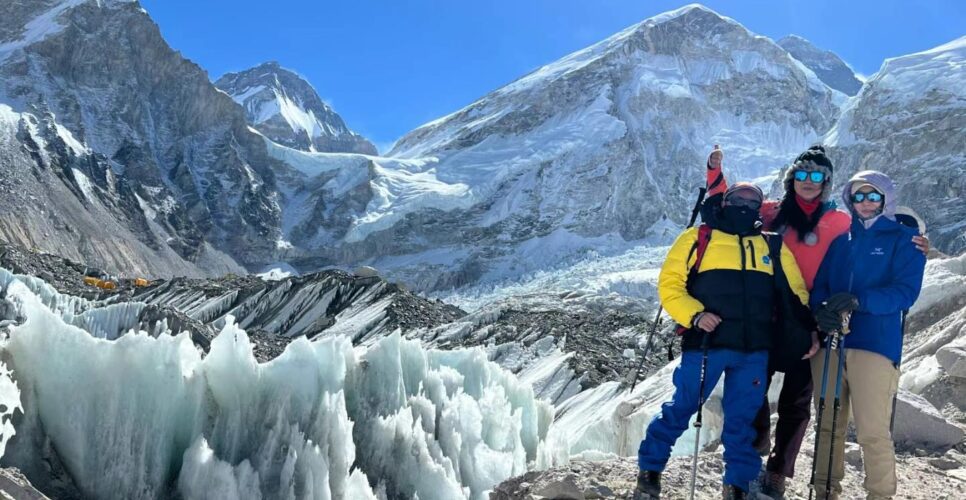
Everest Base Camp, often written short as ‘EBC’, is also the base of the world’s 4th-highest Mt. Lhotse. There are two base camps; the North Base Camp is in Tibet, China, at 5,200 m high. The South Everest Base Camp is in Nepal; the most popular and mainly visited base camp is the South. It is in Nepal, around the Khumbu area at a height of 5,364 m or 17,598 feet. It is the major starting point for the mountaineering expeditions to the summit of Mt. Everest. In mountaineering seasons, especially during spring from March to May, the camp is flooded with worldwide mountaineering expeditions.
Kalapathar High Scenic Viewpoint:
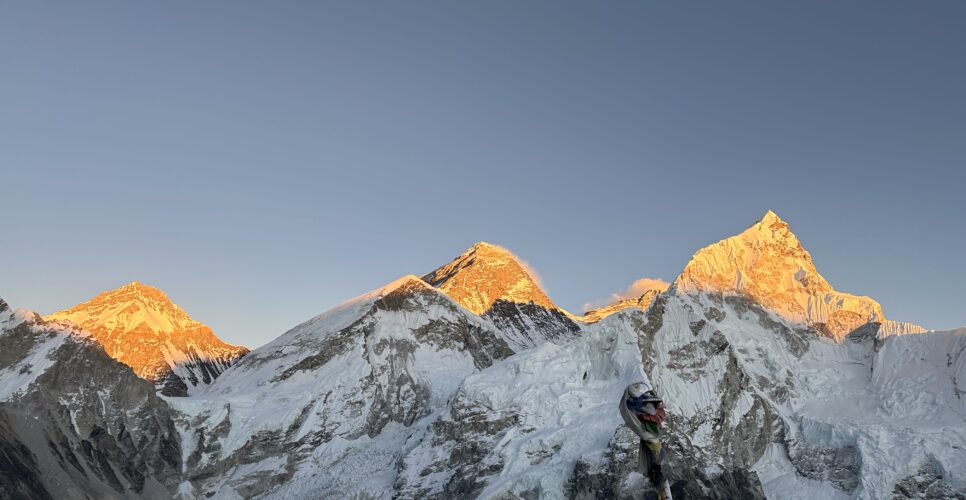
Everest Base Camp Trek by road trip Kalapathar is a high ridge and the most famous scenic viewpoint for close views of Mt. Everest, at a short distance. The name Kala Patthar means “Black Rock” in Nepali. It is one of the notable landmarks situated on the southern ridge of Mt. Pumori above Gorakshep. There are two ridge tops of Kalapathar, the lower is at 5,545 m and the higher top at 5,643 m /18,514 feet. The base of Kalapathar is also a popular landing spot for scenic Helicopter tours of Everest.
From Gorakshep settlement, it takes about 2 hours of steep climbing to reach the highest point of the Kalapathar ridge.
Conclusion for Everest Base Camp Trek by road trip
For the Everest base camp trek by road trip package Vertex Holiday provides knowledgeable guides, dependable porters, strict safety procedures, and individualized support from beginning to end to guarantee a trekking experience that is secure, comfortable, and responsible. Vertex Holiday Company and staff are dedicated to make your trip to the Himalayas easy, fun, and unforgettable, whether that means helping you with permits, eco-friendly activities, or emergency preparation.