Trekking in Nepal with kids is a lovely way to introduce the children to the natural beautiful surroundings of the Himalayas. Nepal and the Himalayas offer various exciting exotic destinations, providing excellent education on flora/fauna and local culture.
Trekking in Nepal with young kids will be one of the most exciting experiences for young ones. Although some smaller kids, need to be carried, as well will have the best time. A great way to get refreshed in the harmony of clean and fresh cool mountain air. Where views of towering Himalayan peaks will certainly impress the family as well as the young children. Trekking in Nepal and around the Himalayas is a wonderful way to spend a leisurely and pleasant holiday.
Rhodondren Forest in Ghorepani
Trekking in Nepal with kids Where walk leads amidst a beautiful forest of tall rhododendrons, oaks, pines, and fir trees, and chances of spotting some wildlife. Making the trek more enjoyable and exciting at the end of the day walks.
Staying overnight in the comfort of a nice local lodge or resort with rooms facing views of magnificent scenery. Trekking in Nepal with young kids is a great way to keep the young ones occupied with lovely scenic views. As well as visiting villages, Nepalese are fond of young children and will greet the family and kids with cheerful smiles.
The children will be amused as well enjoy the way of simple life of the village kids. As they grow up they will learn the lesson of the happy way of living; after recalling the memories of Nepal.
In the past years, Nepal has been an exotic destination for all types of travelers including families with young children. The country still retains its old-time glory and preserves its pristine environment, making Nepal a great premier holiday destination.
Where And How To Enjoy Trekking In Nepal With Kids:
Nepal with boundless scenic and cultural destinations to choose from for leisure, moderate Trekking in Nepal with kids is a little bit of adventure. The best way for a family with young kids to enjoy country walks in Nepal is short moderate treks. Enjoying a few days of treks around the foothills of the Annapurna Himalayas or Langtang Himal region.
Few adventurous parents have dared as young as nine years to Everest base camp. Which is at an altitude of 5,354 m / 17, 565 feet high. Which is very rare and might cause a problem with a child’s right movement, but it has been done. But has remained hidden from the mass public, due to certain rules of age limits of respective human rights.
Annapurna around Ghorepani and Poon Hill is a perfect and safe destination for young kids to trek. Reaching a maximum height of 3,210 m / 10,531 feet high, although the walk leads to a steep uphill. But taking slow and having short stops will make the walk enjoyable. As well the kids will get the taste of fresh cool air, enjoying the grand views of surrounding beautiful scenery.
Trekking in Nepal with kids The walk into the enchanting forest of rhododendrons will be one of the best highlights of the trek. Especially if trekking in the right seasons of the year, like in springtime from March to May. When wildflowers are in seasonal bloom, where the hills and the whole surrounding look bright and lively. Making the whole country an Eden garden like in fabled stories, which is another great delight for young ones.
On reaching the final destination at Ghorepani, staying in the comfort of a nice cozy lodge. Where children will have time to play around with local children and learn a few Nepali languages. This will be another good way of knowing local culture and customs along with foreign languages.
An early morning hike of an hour or more to Poon Hill rewards with stunning sunrise views. Includes wide panorama of Himalayan peaks, the children will be excited overlooking grand snow-capped peaks with the bright sunrise.
Trekking in Nepal with kids A great thrill for parents, as well as for the kids, the journey back to Pokhara is equally interesting. Walking from one lovely village to another facing constant views of a snowy mountain range. Apart from trekking and with marvelous views of mountains, the food is another exciting thing to experience for kids. Having local food might be different, but it adds a different feeling and taste to the kids. Which will remain in his or her memories for a long time till he/she grows up; and becomes wise and familiar with choosing the right types of foods.
Langtang Valley Trekking is another wonderful destination for Trekking in Nepal with kids. Springtime will be the most magical time, when wildflowers are in bloom, making the whole environment bright and beautiful.
A marvelous country walk with a touch of local culture, will be a great wonder for the kids. Where all can enjoy trekking on a pleasant trail with ups and downhill, crossing bridges, will be an adventure for kids. A fascinating place for kids to watch local happy children, and yak grazing on a green meadow.
Trekking in Nepal with kids It will be an exciting and memorable journey for young ones with a touch of altitude on reaching Langtang Valley. Where beautiful settlement of Kyanjin is located at 3,749 m / 12,371 feet high. At Kyanjin Gompa kids can enjoy exploring the local bright culture of Buddhism. Visiting the local Yak cheese processing factory, and having a taste of Yak cheese adds a fresh new experience.
Trekking in Nepal with Kids
The other perfect way to enjoy Trekking in Nepal with kids is a short trek to Namche Bazaar, Everest Region around the Sagarmatha National Park. One can take a helicopter or just enjoy flying on a normal flight to Lukla, a great way to enjoy. Overlooking tremendous Nepal’s country landscapes with a chain of Himalayan peaks, facing Mt. Everest.
From Lukla onwards pleasant walks, children will surely enjoy a good time walking through lovely villages. As well as crossing exciting suspension bridges and staying in the comfort of a nice lodge. Where kids will have time to mix with local children experience the local languages and enjoy local impressive cultures. Walking into a beautiful forest, and heading uphill for a few hours to the famous Namche Bazaar, a large settlement. Where every house is adorned with the age-old beautiful architecture of rich heritage, similar to Tibetan predecessors.
Saturday market is another interesting place to observe in Namche Bazaar, which takes place once a week. Visitors and children can enjoy the busy colorful bazaar and witness the custom and traditional dresses of the native Sherpa.
While in Namche a short hike to the park museum displays wonderful items and various information about flora/fauna. The best place for kids to get knowledge of the mountain peoples and way of living along with tremendous cultures.
The museum stands high above Namche Bazaar facing panoramic views of Mt. Everest, Lhotse, and the beautiful peaks of Ama Dablam.
Includes an array of snow-capped peaks with close views of Kongde and Tharmasarku. Enjoying exciting holidays and trekking in Nepal with kids is truly the best way to enjoy a lively; scenic vacation in the Himalayas.
Tea House Trekking in Nepal is one of the most famous and popular ways of enjoying the adventure around the Nepal Himalayas. As in the early days, the availability of accommodation and food services in the mountains was just in the form of tiny houses that would provide tea and basic food services.
Tea House Trekking in Nepal, from its early days till the present has changed dramatically, where trekkers can have several choices with options. From budget, moderate to high standard accommodations in the lodges or guest houses.
Teahouse Lodges in Gokyo
It is still known as Tea House trekking in Nepal till present, for the past four decades. Trekking in Nepal started first with mountaineering expeditions in the mid-1950s when the first few legendary mountaineers conquered the world’s highest peaks. Many famous mountaineers visited the Nepal Himalayas as early as the 1950s when the French Expedition climbed Mt. Annapurna-I.
It was on June 3rd, 1950 the first above 8,000 meters peaks ever summited and conquered by the late M. Herzog. From then on more mountaineers visited Nepal like the big British Expeditions of 1953.
The famous mountaineers late Tenzing Sherpa and Edmund Hillary reached the summit of Mt. Everest on May 29th, 1953; and made history in mountaineering.
Tea House Trekking in Nepal All mountaineering expeditions involved long walks to reach the respective mountain base camps of various peaks in Nepal. By then all trekkers needed to carry camping gear and equipment, walking through remote villages of Nepal’s Himalayan high hills. Tea House Trekking in Nepal The facilities of tea houses were unknown almost taboo, for local Nepalese and pilgrims in the olden days. By then the only shelter they could find was overhanging caves, which are found all around the foothills of the Himalayas. Some could find refuge in local houses of minimum comfort and cook their meals.
As years went by with mass flow of foreign visitors began to travel all around the Nepal Himalayas. Then the Tea House came into existence in the early mid-1970s till now, and where House has changed into nice cozy lodges.
Establishment Of Tea House Trekking in Nepal Himalayas:
Tented camping with full logistic support was required in the past, slowly as the influx of trekkers arrived in Nepal. The main interest for foreign trekkers’ destinations was Everest, Annapurna, and Langtang Himalaya region. Where the first Tea Houses were established, mostly for individuals or small groups of trekkers.
Who could spend overnight in a local village en route and have simple foods with basic accommodations? By then tented camping was much more popular, for those who booked with the local reputed companies.
Camping was the only way to enjoy the trek with good comfort and nice meals throughout the trekking adventure. It was much fun in the harmony of camping with dozens of camping and trekking staff with guides and porters.
Slowly the scenario began to change, after a few decades the trekkers found more comfort in local lodges. As the villages on the main popular trekking routes of Annapurna, Everest, and Langtang, the Tea Houses have flourished.
At present trekkers can enjoy the comfort and luxury of staying in various standards of lodges. From budget, moderate to deluxe, most lodges are clean with spacious bedrooms, having attached or common toilets and baths.
As well as large and cozy well-furnished dining rooms, having potbellied stoves keeping the rooms warm. Provides a long list of comprehensive food menus to enjoy from breakfast, lunch, and dinner, with side snacks and refreshments. Some lodge restaurants also provide fresh bakery products, including internet and Wi-Fi, as well as facilities to charge electronic items.
In the early days, the facilities of accommodation in local huts were established it was tagged as Tea-Houses. But later on, the smaller tea-houses, have turned into a nice fancy lodge with better facilities for trekkers. Along with the standard food menu, making the trek around Nepal Himalayas more enjoyable and exciting.
Trekkers can experience an enjoyable moment in the harmony and warm hospitality of the lodge owners and local management. Besides nice and well-built tea houses and lodges around Annapurna, Everest, and Langtang region, the village committee also runs Home Stay. A unique and new mode of attraction among travelers, where visitors can spend in a local hut or cottage.
Trekking Areas With The Best Tea-House / Lodge Facilities:
Stone Thatch Roofed Teahouse Lodge
Depending upon the quality and facilities for trekkers around the Nepal Himalayas, the best tea houses and lodges are popular trekking destinations.
Likewise, Annapurna Region around Annapurna Circuit Trail, Annapurna Base Camp, and most popular scenic Ghorepani and Poon Hill.
Including the Manaslu Circuit route, where trekkers can find the best available accommodation with a good food menu. Depending upon the time of good seasons of the year, where some lodges can be overbooked. The next best available Tea-House lodges are in the Everest region around high Khumbu areas from Lukla to Namche Bazaar.
As far as Gorakshep is near en-route Everest base camp, including around Gokyo Valley and Thame villages. Trekkers can enjoy the comfort from basic, moderate to luxury standard hotels, lodges, and resorts as per one budget for the trek.
Langtang Valley and around the Langtang Himal region is another popular and best trekking destination around Central Himalayas. Trekkers can find simple to standard lodge accommodations and good food at Langtang Valley and Gosainkund trekking.
Some isolated remote areas of trekking where lodges are simple and basic but have facilities with solar or electric power.
Around the Far East like Makalu and Kanchenjunga areas, the facilities of Tea-House / Lodge are fewer only in major villages. As well For far Western Nepal like Dolpo and Limi Valley, tea houses are available only in the main large villages.
Tea House Trekking in Nepal The best Tea House accommodations and foods are available only on major mainstream trekking routes. On off-the-beaten trails around remote corners of Nepal Himalayas, trekkers need to join good reliable local agencies.
Without Tea House Trekking in Nepal Where the companies will provide all necessary camping equipment with field staff, guides, and porters to carry all the gear. Required for trekking around the remote Himalayan destination, the classic and original ways of spending overnights in tented camps.
In all camping treks, the food is prepared by the expert cook and kitchen staff. Meals are prepared in camping kitchen tents of great variation, it is another way to experience the adventure around Nepal Himalayas.
The Colorful Mani Rimdu Festival is a religious event, one of the world’s highest religious and exciting festivals to experience. The Mani Rimdu Festival is an important religious carnival and celebration for the Sherpa natives held only around the Everest region.
There are three Colorful Mani Rimdu Festivals which take place in several areas of the Everest region. At Thame Monastery west of Namche Bazaar and Khumbu region, as well as in Tengboche Monastery en route to Everest base camp. Including in Solu the lower mid-hill south of Everest at Chiwang Gompa / Monastery.
The festival and prayers last for 19 days, but the main occasion takes place for three days. Interested people can visit all these beautiful areas to observe the colorful Mani Rimdu Festival.The most preferred and popular is the Mani Rimdu Festival at Tengboche / Thyangboche Monastery 3,867 m / 12,687 feet. Due to its location which falls on the main trekking route from Namche Bazaar to Everest Base Camp.
Mani Rimdu Festival is an occasion to mark the establishment of Buddhism by Guru Rinpoche, also known as Tantric Guru Padmasambhava. Who visited Nepal’s high Himalayas on his way to Tibet an invitation by King Dristen in the 7th century A.D.?
The reason for inviting Guru Padmasambhava was to help King Dristen to build Samye Monastery close to Lhasa near the Brahmaputra River.
Guru Padmasambhava was also a reformer of Buddhism as well who established the Nyingma sect of Tibetan Buddhism. Mani Rimdu is regarded as the holiest festival for the Nyingma sect of Buddhism, especially held around the Sherpa communities. Visitors can choose the areas and time to observe and take part in these colorful events at chosen destinations. Around the lower Solu area or at the Khumbu region in Thame or Tengboche monasteries, the festival is similar despite the locations.
Mani Rimdu Festival is, an interesting event worth visiting as well as a lifetime experience to watch and observe.
Mani Rimdu Festival Events:
Mani Rimdu Festival only the time and places are different due to Sherpa settlements at various parts of the Solu-Khumbu district.
The Colorful Mani Rimdu festival is one of the most important religious events for the Sherpa. The event is marked according to the Tibetan Buddhism Luna calendar, it is a series of masked dances. Where monks and priests dressed in elegant masks and costumes dramatize the triumph of Buddhism over Bon. Which is one of the ancient animistic religions of Tibet as well spread around Nepal Himalayas.
The monks of all monasteries of the Sherpa land in the Everest region of Solu and Khumbu. Performs the religious ceremony wearing colorful attire and chanting prayers and playing ritual instruments, burning incense to wade evil spirits. As well for a good harvest of barley, and buckwheat the main crops of highlanders, the ceremony lasted three full days.
Colorful Mani Rimdu Festival Mani Rimdu Of Solu:
Colorful Mani Rimdu Festival The Mani Rimdu of Solu is held in Chiwong Monastery at nearly the same time as in Tengboche Monastery during the autumn season.
The 9th month according to the Tibetan Buddhism calendar falls in the Full Moon times. The sacred ceremony is a sequence of 19 days. It completes on the last three days when visitors are allowed to take part in this colorful festival Mani Rimdu.
Where all villagers and guests, visitors devotees get blessed by the high priest. The locals and other visitors also bring offerings like seasonal fruits, refreshments, butter, and crops.
Colorful Mani Rimdu Festival Mani Rimdu Of Thame:
Mani Rimdu of Thame takes place at the oldest monasteries of the Khumbu region of Everest. Thame at a height of 3,880 m high, is located at the west end of Khumbu and the famous Namche Bazaar. A quaint sleepy village, where trekkers often visit Thame which is on the route of the Old Trans Himalaya Caravan Salt Trade. As well as on the high trekking trails to Gokyo Valley via Renjo-La Pass.
The monastery of Thame with a history of 500 years, is perched above Thame village within windswept terrain. The Mani Rimdu Festival falls on Full Moon during late spring and pre-summer time of June or the end of May. According to the Buddhist calendar for the auspicious occasions to celebrate the grand event of Mani Rimdu.
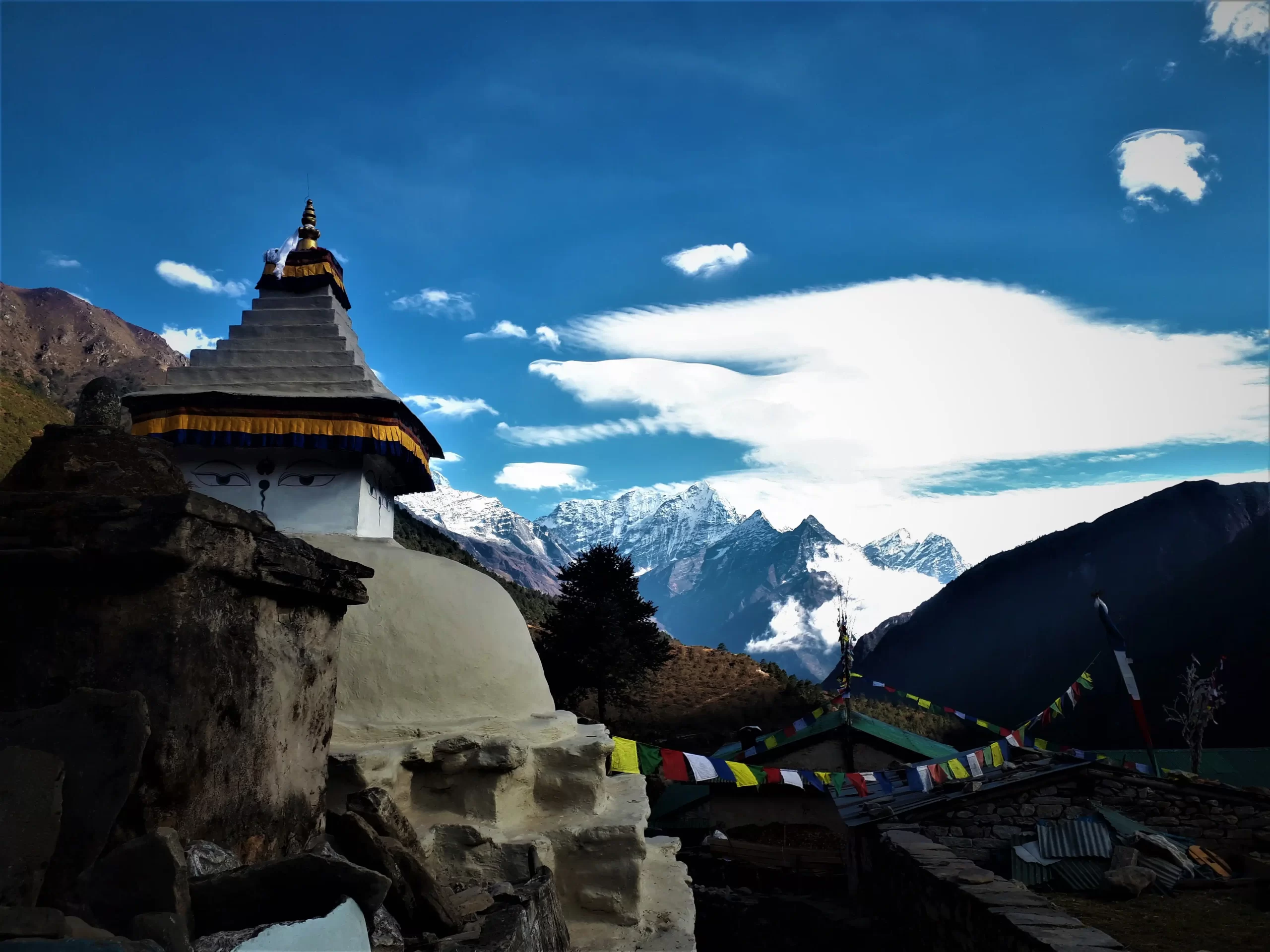
A stupa near Thame, Everest Region
Mani Rimdu Of Tengboche / Thyangboche:
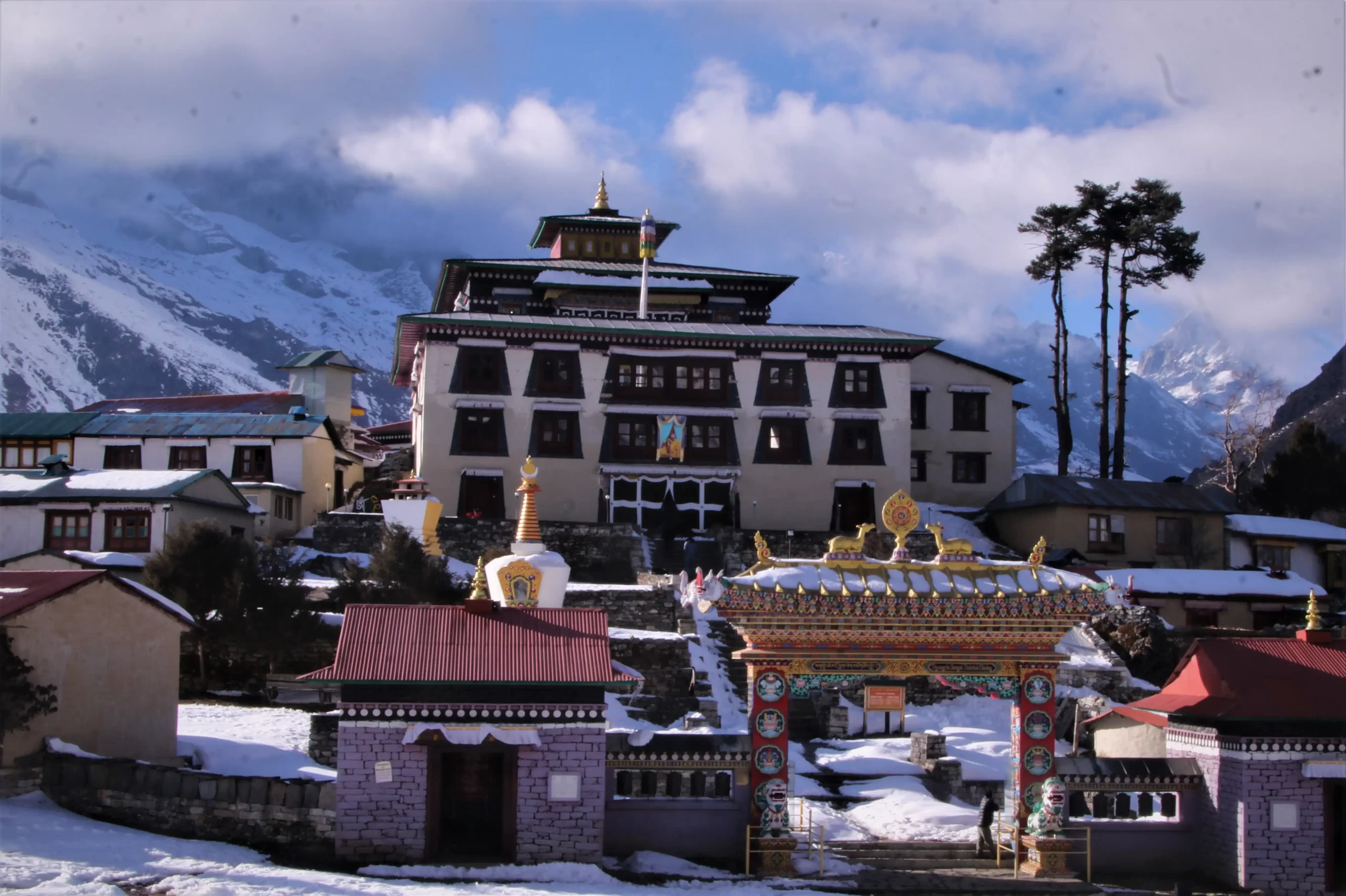
The colorful Mani Rimdu Festival of Tengboche is one of the most popular among outside visitors as well for local villagers. As it is situated on the famous route to Everest Base Camp, the place itself is spectacular for grand panorama.
The Tengboche was established by the great gurus of the Rongbuk monastery from Tibet, built in the last century. Which was damaged by earthquakes in early 1912 and rebuilt, but the fire destroyed it again in 1991. At present, it stands majestically in the shade of Mt. Everest and magnificent Ama Dablam, surrounded by an array of peaks. A picturesque location and a photographer’s paradise amidst a beautiful alpine forest of rhododendrons, pines, firs, and juniper trees.
The festival takes place from the end of October to the first week of November, a great colorful event. The festival begins inside the monastery courtyard with a prayer ceremony, where few visitors are allowed. But at the concluding ceremony on the last three days, which is most colorful and interesting to observe.
Where all visitors and devotees are welcome to immerse themselves in the event and as well take blessings from the high priest. Truly an interesting and joyous celebration to watch and take part in the Mani Rimdu Festival.
Various Routes To Enjoy Tengboche Mani Rimdu Festival:
Of all the colorful Mani Rimdu Festival one can enjoy the trek around Solu or high Khumbu. As per the date for the events, trekking the lower side of Everest around Solu to join for Mani Rimdu festival. A lovely walk to the high Peak Hill viewpoint where one can catch a 360° wide panorama of Himalayan peaks.
Includes Mt. Everest, Lhotse, Makalu, and Kanchenjunga amidst a beautiful forest of rhododendrons and pines, after enjoying the trek. Walk towards Phaplu to join in the colorful Mani Rimdu festival, a great combination of culture and scenic views.
Visitors interested in a higher trek to Everest base camp or just a week more walks can enjoy the Mani Rimdu Festival. Walking from Lukla to Namche Bazaar and then towards Tengboche Monastery for the event. Trekkers can enjoy walking to Everest base camp before and after the festival of Mani Rimdu also.
Travelers can also enjoy the Mani Rimdu Festival of Thame Monastery, a few days’ walk from Lukla to Namche Bazaar. After a pleasant stop at Namche Bazaar for acclimatization, a day walk to Thame to observe the Mani Rimdu Festival.
Trekking Everest three passes or Thame one can enjoy an adventure to Gokyo scenic valley crossing the high Renjo-La Pass before or after the festival.
Tiji Festival of Lo-Manthang is one of the most spectacular religious and cultural events. One of the main traditional heritage of Upper Mustang falls at the end of spring in May. Where days are much warmer with enough sunshine for views and tours as well as observing the grand Tiji Festival.
The Tiji Festival is held annually with a pomp and colorful ceremony, the colorful religious events last for three days. Where thousands of people from all over Mustang attend, as well as visitors from worldwide to be with the jubilant crowd. Upper Mustang natives follow the same cultures and religion of Tibetan Buddhism similar to its predecessors, across the border.
Upper Mustang, is geographically an extension of the huge South West Plateau of Tibet / China. Much of the country is dry with windswept terrain and landscapes, but beautiful with picturesque landscapes to experience.
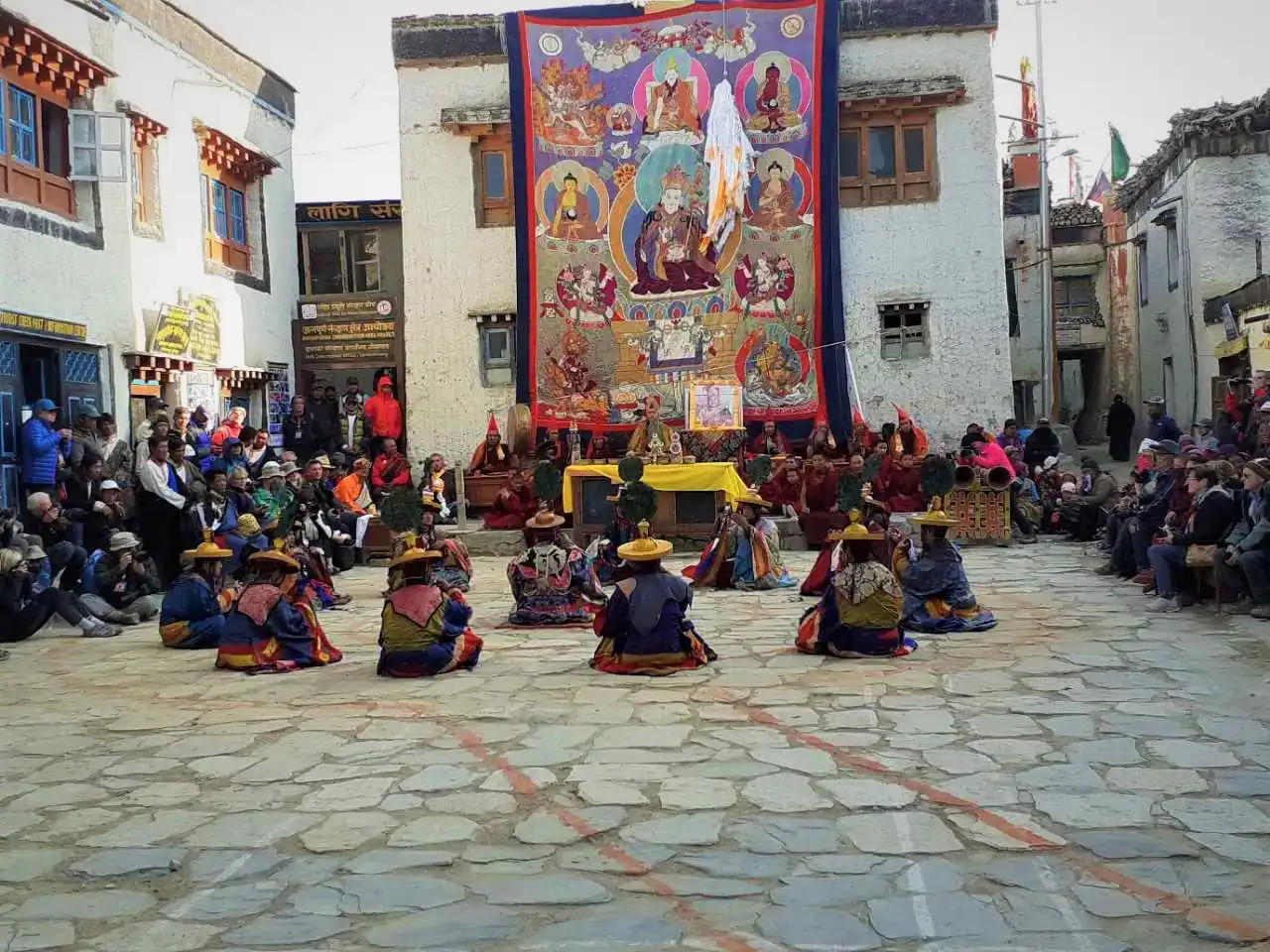
Cultural Ceremony of Tiji Festival
At one time Upper Mustang was part of Tibet but became an independent kingdom. The history begins in 1380 AD, when a warrior and followers of Buddhism from South West Tibet established a separate kingdom.
Which was known as Lo and the people were called Lobas, later changed to Mustang with Lo-Manthang as the kingdom. Ame Pal the first Raja / King in 1380 AD defeated his enemies and local warlords.
Then built a great wall around the capital Lo-Manthang to keep the intruders away from his kingdom. The former walled kingdom of Lo Manthang still exists as it has been for hundreds of centuries. As the years passed by, changes have been made with networks of roads and semi-modern facilities, but still retaining its old-time glorious.
A great country and the former forbidden kingdom are worth a visit and to be in the great Tije festival. Visitors are warmly welcomed to take part in the events as well as to experience the culture of the Upper Mustang. Besides attending and observing the Tiji Festival one can take a tour around the walled kingdom at places of great interest. The former walled kingdom of Lo Manthang takes you back to medieval times, with its old town and cobblestoned streets.
Tiji Festival And History:
From 1380 AD, the Upper Mustang was established as a separate kingdom by the first warrior king Ame Pal. As the years went by the Tenchi or Tiji ritual was practiced during the rules of Lowo Khenchen. The third son of King Tsangchen Tashi Goen, and a group of people from every village. Monks and priests of Chode Monastery started the Tije Festival, the ritual of chasing devils and evil spirits.
As well as to mark the end of a dry season to welcome the new era with great worship. As well as holding special prayers for a better harvest of buckwheat, barley, and wheat, the main crops are grown on high terrain.
The Tiji Festival ceremony continues for three days to enjoy the lively activities of monks and priests. Dressed in colorful attire dancing with the strong beat of religious music and reforms of the history and stories. Which is the main act of wading demons and evils from the areas of Upper Mustang the land of Lobas.
The Tiji festival of Upper Mustang is one of the most celebrated religious events full of excitement. One of the royal heirs of Ame Pal, raja-king Samdup Rabten of Mustang. Started this festival during the 17th century, inviting nearby kingdoms kings, and royals of other districts to join the Tiji Festival.
The word Tiji is a common name for Tenpa Chirim (bstan pa spyi rim), linked with the most popular Himalayan festivals. The religious festival was introduced during the time of Ama Pal (the first king of Lo). Who was the first ruler of Lo or Mustang followed by Ngorchen Dorje Chang?
The exalted person who brought Buddhism to Mustang. Tenchi, the Vajrakilaya ritual was brought into practice during the reign of Lowo Khenchen. The son of the 3rd independent king of Lo Tsangchen Tashi Goen. This festival is organized by a group of people including mediators or village chiefs from every village and the Monks of Chode Monastery. The festival was held successfully from the time of Ame Pal. To guard the kingdom of Lo against evils, chasing the demons from the sacred land of Lo Manthang. The festival marks the end of the dry season and prayers for a fruitful harvest.
It is interesting to be part of the Tiji Festival, considered one of the most celebrated festivals around the Himalayas.
For interested visitors, the day’s dates for Tiji Festival 2023 and 2024 will be on the 16th, 17th, and 18th of May 2023. As per Buddhism Lunar calendar was chosen as an auspicious time for the festival.
How To Reach Lo Manthang For Tiji Festival:
There are various ways to reach Jomsom and Lo-Manthang to be in the Tiji Festival. The easiest and fastest means is taking a short flight of 22 minutes to Jomsom town. From Jomsom, either spend overnight or continue the journey by overland on a four-wheeler jeep.
From Jomsom sharing or hiring a jeep for the group for the whole trip, drive leads on muddy dirt tracks. Heading past Kagbeni village, the entrance and exit point of Upper Mustang, where all foreign nationalities require special permits.
Upper Mustang from Kagbeni village onwards is listed as a Restricted Area, which was closed to outside visitors. It was opened in 1992 onwards and still controls the mass flow of travelers with people who can afford special permits.
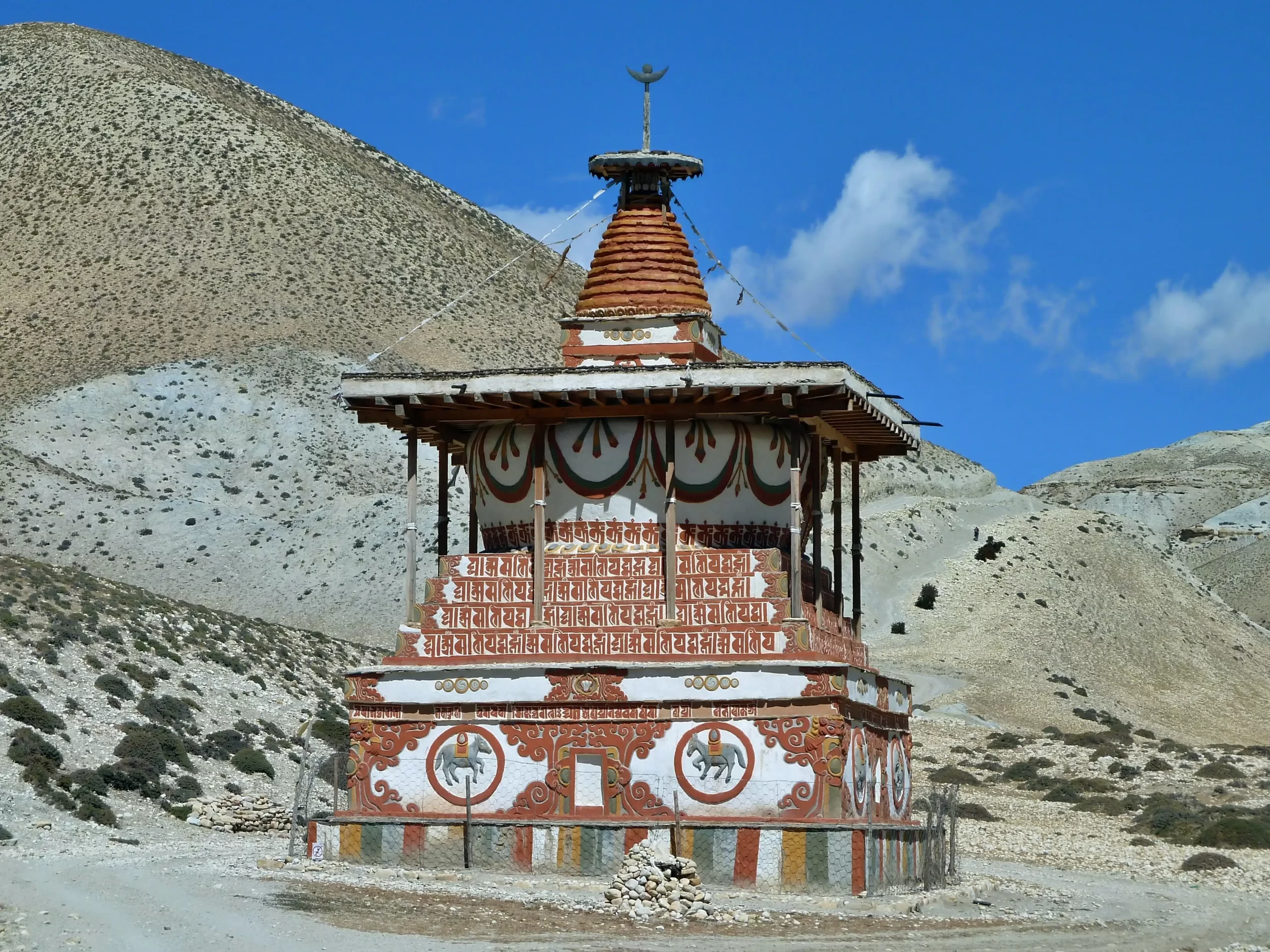
A Bon Buddhism Stupa
From Kagbeni enter the wild and rugged country of Upper Mustang, but beautiful and picturesque scenery of landscapes. Drive heads beneath a great wall of the canyon and towering windblown cliffs to reach Chuksang / Tsuang at 2,980 m.
Staying overnight in a local lodge, start the journey driving up to several high passes facing incredible views. Includes scenery vast plain of Mustang with snow-capped peaks of Mustang Himal. Drive leads past a few nice traditional villages with a field of barley and buckets enclosed by a few willow and populous trees.
The second day’s drive reaches Ghami 3,540 m, a lovely village and one of the major settlements of Upper Mustang. Staying overnight in the comfort of a nice homely type lodge or guest house. Next morning short drive to Charang / Tsarang village 3,759 m reaching by lunchtime. Afternoon hike to Ghar Gumba or Lo Gekar Monastery, a nice place surrounded by a big crop field of barley.
On the third day drive to Lo Manthang 3,840 m high, and enter the former forbidden and walled kingdom of Lo-Manthang. Transfer to the best lodges and guest houses and enjoy a short walk around the old streets of Lo-Manthang and witness the preparation of the Tiji Festival.
At Lo Manthang for three overnights to observe the colorful Tiji Festival and local activities. As well tour of famous monasteries and the fort palace of late last raja Jigme Dorji Wanchuk Bista. Rest of the days at Lo Manthang enjoy the Tiji Festival at Choedhe Monastery till the end or closing ceremony of the event.
Return journey on the same way back to Jomsom town. Where one can choose the options of driving or a short flight back to Pokhara.
Distance by road from Pokhara to Lo-Manthang is 237 km. Pokhara to Jomsom 159 k.m. and from Jomsom to Lo-Manthang 59 k.m. / 37 miles. Upper Mustang Trek during the Tiji festival is one of the most popular times to visit, as one is able to witness the colorful Himalayan Bon Buddhism culture up close and personal.
Upcoming Tiji Festival Dates for the years 2024, and 2025 are as follows.
S.No: Tiji Festival Year Dates of Tiji Festival Events
01 Tiji Festival 2024 5th, 6th and 7th May 2024 02 Tiji Festival 2025 24th, 25th and 26th May 2025
Manaslu Circuit & Larke-La Pass Adventure is ‘an adventurous traverse from one scenic valley to another beautiful location and adventurers around the world must have trekked and explored most of the popular areas of the Nepal Himalayas. Over the past decades and present Nepal’s Himalayas still stands as the number one trekking destination, as well for various adventures.
Trekkers in search of fresh new destinations around the Himalayas. Vertex Holiday suggests scenic and cultural treks around the Manaslu Himalaya range. Where one can enjoy Manaslu Circuit crossing high Larke-La Pass a traverse from the picturesque valley of Manaslu to beautiful Manang. For this exciting and wonderful adventure, Vertex Holiday provides full information on how and when to book with other useful details.
For travelers interested in providing the important, necessary information to make your adventure holiday memorable, enjoyable, as well worth the experience.
01: Useful Tips for Manaslu Circuit Adventure:
Staying healthy and physically fit. Book with the right and reliable local or overseas trekking agencies. Make sure the company is registered with the Nepal Government’s respective Tourism Department. Get information about the trek departure dates.
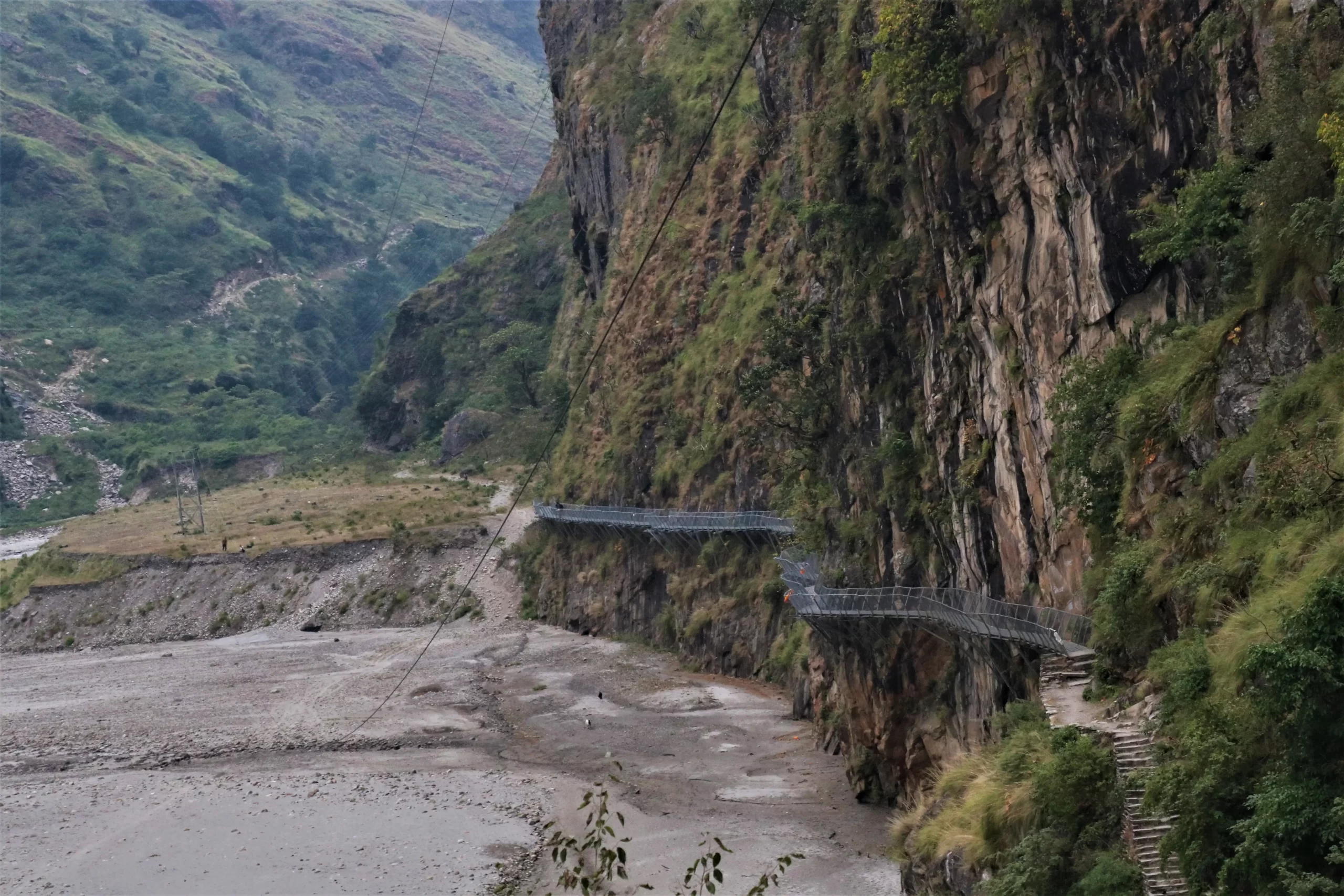
Hanging Trail during Manaslu Circuit and Larke La trek
Check the date of departure that fits with your holiday from work. Search the website to choose the company of your interest and choice. On booking acquire much information regarding the trip. Purchase the trekking gear required according to the season. Understand the nature of trekking and the group size to join. Get to know about the trip cost with includes and excludes.
02: How to stay fit before and after booking the Larke-La Pass Adventure:
Know about the terrain and trails including the altitude of the trek before departure for Larke-La Pass Adventure. Practice some light exercise few hours of walks ups and downhill. Jogging, swimming, aerobics, and Zumba or Yoga exercise. Check with your family doctor regarding AMS symptoms (Acute Mountain Sickness) or other common sickness. Know about your past medical history to be aware of. Check which food is right and best for you to keep fit. Get information on what types of food, and meals are available on trekking.
Inquire regarding the local hospitals and health posts available on treks. Be prepared for the standard itinerary that suits your time in Nepal. In case of server sickness and accidents, what are the means to get back?
03: Packing and buying the right gear for the trek:
Make sure your passport does not expire within 6 months of travel. Legal passports and carry at least 6-8 PP. size photos if required. Carry all necessary documents required for the treks. Purchase Travel & Medical Insurance it’s a must and important. Know the shortest air route to Kathmandu, when buying airline tickets. Get the right clothing and trekking gear required as seasonal wise. Make sure if sleeping bags and duffel bags are provided by the local agents. Buy perfect-fitting trekking boots that can withstand rain and snow. Inquire about the things that can be bought in Kathmandu for the trek including trekking maps of the area. Get the visa from your own country from the Nepal Embassy or Consulate if not available. On arrival at Kathmandu International Airport can obtain the visa. Carry US$, Euro, Sterling Pounds, or any other foreign convertible currency in cash also to get a visa from the airport. As well as to pay the remaining balance to local agents or by credit card, where a 5 % surcharge is added. Get to know the location and standard of hotels in Kathmandu.
04: Things To Know About Local Culture during Larke-La Pass Adventure :
The upper Manaslu of the Larke-La Pass Adventure is populated by Buddhist religion and culture. Respect the local heritage and culture. On trekking or traveling anywhere take care of local ecology. Follow the rules as maintained by the local villagers. Ask your guide or village person when taking photos of people or inside the monasteries. Maintain hygiene and take care of litter and the fragile environment. Be happy and show your right positive attitude to enjoy the holiday.
05: Trekking Routes, Trails & Village Including Local Lodge:
Using hot showers and re-charging electronics ask the price first. Maintain the rules and customs of the villages and lodges on the route. Never bargain on food and accommodation except when buying souvenirs. Check the food menu and order as per your delight. Always be thankful to the villagers and lodge owners depending upon the services.
Use only boiled filtered water for drinking and ask for the price per liter. Interacting with locals feel safe and enjoy their culture and customs. Make sure what types of transportation are provided for the drive start of the trek and at the end.
01: Staying Healthy And Physically Fit As Well As Being Aware Of The Trekking With Full Information:
01: Useful Tips for Manaslu Circuit and Larke-La Pass Adventure :
Always best to make yourself fit and healthy to enjoy the rest of your life as well for the trek in the Himalayas.
First and most important is staying fit sound, and healthy to cope with the Himalayan high-altitude terrain. Being fit and in good health physically then search for the best local agents in Kathmandu, Nepal. For instance, Vertex Treks & Expeditions is a company known for reliable and best services and affordable prices.
All reliable local companies to choose from should be recognized by the Government of Nepal Tourism Department, as well as by TAAN. (Trekking Agents Association of Nepal). Including trekking guides holding government-approved licenses to guide.
Check the date of departure that fits with your holiday from work. Get information about the trek departure dates. Make sure that you have picked the right dates and itineraries as per your holiday duration for the trek.
Search the website to choose the company of your interest and choice. Before booking the trip of your interest and choice surf the websites to find the right local company. As well as the standard of the services that are provided according to the trip price, checking the dates for trek departures. If not joining with the group inquire if it’s possible to join the trek as an individual or solo.
On booking acquire a lot of information regarding the trip. Before booking the trip get to know much of the trek itineraries, with all information and details related to Manaslu Trekking and Larke-La.
Being aware nature of the trekking trails, and altitude with safety measures required for the trek. As well as information on the guide to lead the trek, and how safe and responsible the company can take care of.
Purchase of the trekking gear required according to the season. Make sure of the trekking list and items to buy from home before the trek departure and flying to Kathmandu. Inquire if it’s too much to carry from home, and ask if it can be bought or hired in Kathmandu.
Understand the nature of trekking and the group size to join. It is important to know the trail condition and route of the treks, as well as the number of trekkers in the group. Making sure the nationality of each person joins makes the trek more enjoyable knowing the members for the trip. Remember Manaslu is a Restricted Area, where a minimum of 2 people is required, solo and individual trekkers are not allowed. Where trekkers for Manaslu Circuit must join with a reliable local company led by Government authorized and licensed guide.
Get to know about the trip cost with includes and excludes. After paying much of the trip cost, must be fully aware of what’s included and excluded in the trip cost. So that they won’t be any misunderstanding between you and the company. If in doubt there is always time to discuss with the respective companies if something is missing in the trip cost. Must declare before the trek departures, as the guide only follows the rules of the company.
As well as guiding the trekkers safely and soundly offering information on the respective areas of trekking.
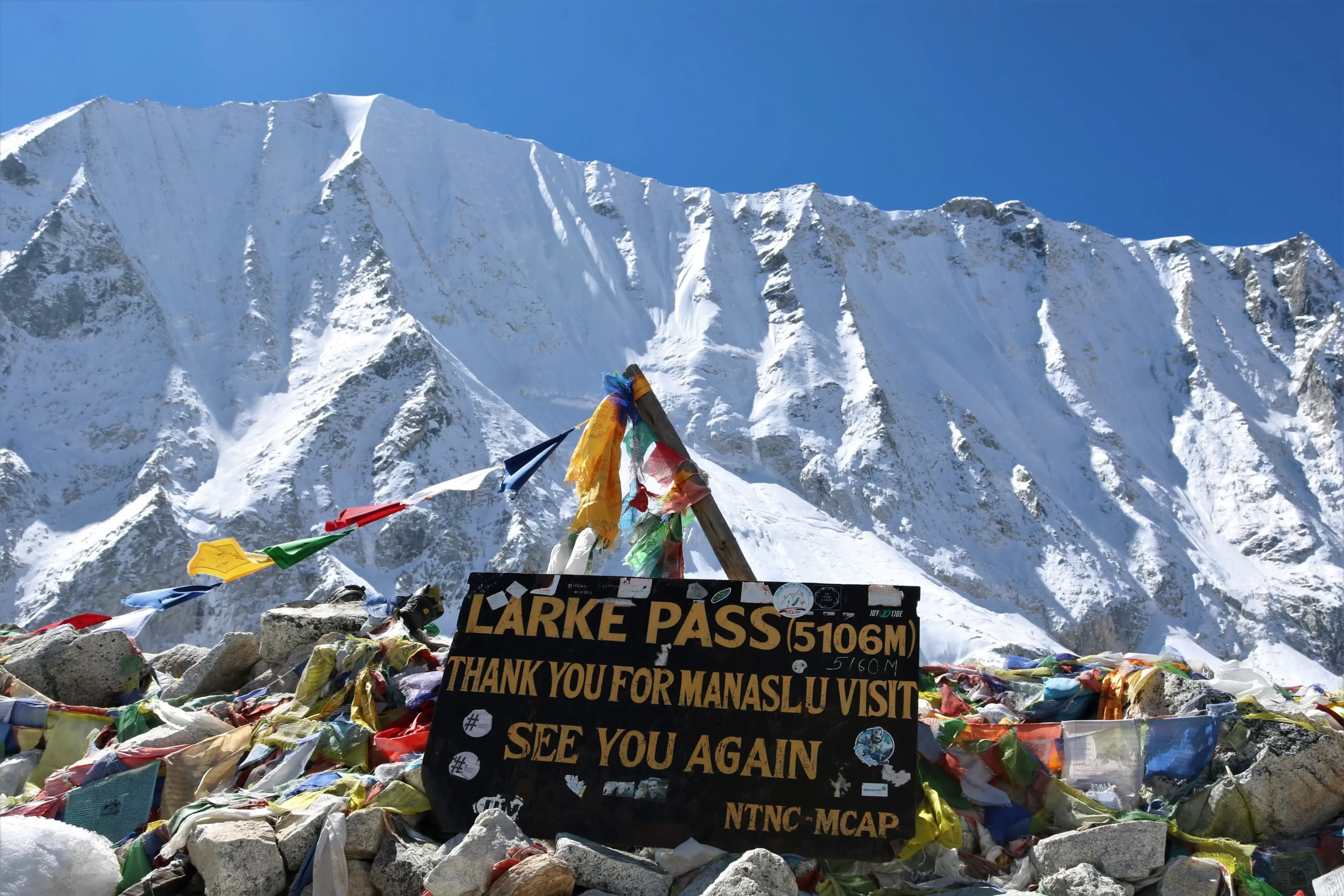
Larke La Pass
02: Staying Fit For Manaslu Circuit and Larke-La Pass Adventure :
A physically fit person can enjoy the best of holidays, as well as being healthy and wise taking the right types of food to stay fit. Therefore the following points must be taken care of before taking on the Manslu Circuit and Larke-La Pass Adventure.
(a): Know about the terrain and trails including the altitude of the trek. Staying fit will be a great advantage to enjoy the whole trekking. As well as to rejoice in the harmony of local cultures and scenic views. The first thing is to know the trail conditions how steep up to climb and descent as well. Including gain in altitude every day before reaching the overnight stop.
(b): Practice some light exercise few hours of walks ups and downhill. A simple exercise will be great to start with a walk of a few hours walking or running ups and downhill. But do not overdo it to make yourself tired and breathless, take it easy at a normal safe pace and get advice from the concerned agents or medical experts.
(c): Jogging, swimming, aerobics, and Zumba or Yoga exercises. A short Jogging around your hometown or in the park, daily an hour jog in the morning or late afternoon. Besides jogging exercises, swimming aerobics or Zumba are best to keep yourself fit and healthy, including some Yoga practice for breathing and leg and lung exercise.
(d): Check with your family doctor regarding AMS symptoms (Acute Mountain Sickness) or other common sicknesses. Before and after booking the trip, get a medical checkup even though you are fit and able. But altitude sickness or AMS can occur to any fit person at any time if one is not careful. Where your doctors or friends who have trekked in the Himalayas will help you with information regarding the AMS.
The company that you have booked will also provide information and details of altitude sickness symptoms and how to take precautionary measures.
Know about your past medical history to be aware of. Most people being busy at work might be unaware of some hidden medical problem that you do not realize. If some people have done some minor or major operation or surgery, and taking pills as per the medical advice. Better to know your past illness so that on treks the old symptoms won’t occur, and your guide and leaders should know also about your medical history. So that they can take extra attention and care for you if needed.
Check which food is right and best for you to keep fit. One of the most important is your diet, and what you consume and eat most as at present more western people are vegetarian. If you have a special diet or are allergic to some foods, let the company know beforehand then the guide will provide you with food of your choice during the trek.
Get information on types of food, and meals available on trekking. It is better to know and be aware of what types of food are served on route trekking on overnight and lunch stops. Most standard lodges around bigger villages and settlements serve a full comprehensive food menu.
From Continental, Indian, Chinese, Nepali, and Tibetans some places serve Italian, Mexican, Japanese, or Korean cuisine also. Including fresh bakeries’ products as well. Order according to the menu where most foods are cooked hygienic, some smaller villages have basic lodges, and provide simple meals but good, but especially the Nepalese famous Dal Bhat, or noodles and Tibetan bread or Chapattis, unleavened bread. (i): Inquire regarding local hospitals and health posts available on treks. Best to know about medical facilities available on route treks around the main villages, and what precautionary measures are taken by the local company or guides. As accidents and unfortunate incidents can happen anywhere and at any time.
Be prepared for the standard itinerary that suits your time in Nepal. Always know the full itinerary details, about precautions, and the route of trekking and places for overnight stops. Regarding the local culture and custom as well the itinerary have enough days for acclimatization and exploring the local villages. As well the itinerary suits your international flight schedule and the duration of your holidays for the trek.
In case of server sickness and accidents means of transportation? One of the most important is knowing, what means of transportation are available on route trekking. If someone has to return home earlier breaking the trip halfway, due to a personal problem. As well as if someone gets very sick or gets wounded by unfortunate accidents.
Right to know the types of fastest transport for emergency evacuation, which will be walking back to a road-head getting on local vehicles, or using the helicopter services. This is why you’re medical and travel insurance comes in handy and important to claim the cost incurred by sudden illness or accidents.
03: Packing & Buying The Right Gear For The Larke-La Pass Adventure Trek:
Packing and buying the right kinds of equipment and clothing will make it worth trekking during the Larke-La Pass Adventure, as well as carrying the necessary documents and papers required for Nepal and trekking.
Make sure your passport does not expire within 6 months of travel. The first thing is to check your main ID and passport, which should not exceed the expiry date minimum of 6 months. For dual citizen passports, use only one country passport. It will create problems in acquiring a Nepal visa and necessary trekking permits.
Legal passports and carry at least 6-8 PP. size photos if required. Make sure to carry a passport with dates that do not expire within 6 months of traveling overseas. Carry at least 6-8 recent passport-size photos, required to obtain the Nepal visa as well as trekking permits.
Carry all necessary documents required for the treks. Check that you have all the necessary documents required for the treks and travel when leaving your home country.
Purchase Travel & Medical Insurance it’s a must and important. Most importantly getting the best Travel & Medical Insurance should cover all medical bills incurred. Including expenses on emergency evacuation by various means of transportation from private vehicles to Helicopter services if required.
Packing and buying the right gear for the trek: The other important is buying the right types of trekking gear as per the list provided by Vertex Holiday. At present, most of the trekking gear can be hired or can be bought in Kathmandu as well. If it’s too much to carry from home at a reasonable price.
Know the shortest air route to Kathmandu, when buying airline tickets. To make it easier find the airlines with the cheapest and best shortest route to Kathmandu from your home country. Normally transit is mostly in Middle Eastern countries when traveling from Europe for the flight to land at Kathmandu-Nepal International Airport.
Get the right clothing and trekking gear required seasonal-wise. When buying warm and light clothing season-wise, where spring is quite warm in the lower areas of Manaslu. But be prepared for the cold climate around Upper Manaslu till the end of trekking.
Make sure sleeping bags, duffel bags are provided by the local agents. Important to know if sleeping bags and duffles is included in the trip cost. If not one can bring a four-season sleeping bag with an inner linear, necessary to use a sleeping bag of your own. Even though spending overnights in the comfort of a nice local lodge. Duffel or kit bags, are best to have semi-waterproof, one can buy them in Kathmandu as well of good quality.
Buy perfect-fitting trekking boots that can withstand rain and snow. The first important thing when buying trekking gear is trekking boots, buy a little larger. So that it can fit with thick socks required in cold mountain terrains. As well as a few centimeters of space for the movement of your toes from the cold freezing temperatures. The boot to buy that is snow or water-proof, if not carry a wax to put on boots in snow-rain conditions.
Inquire about the things that can be bought in Kathmandu including trekking maps of the area.
Besides normal gear to bring from home, due to flight weight allowance. If it’s too much to carry. Where most items required for trekking are available in the stores and shops in Kathmandu as per your choice of brands. Make sure with your booking agents the things that can be bought in Kathmandu.
Do not forget to buy the best trekking maps in Kathmandu of the trekking area and routes.
Get the visa from your own country from the Nepal Embassy or Consulate if not available. On arrival at Kathmandu International Airport can obtain the visa. On booking with Vertex Treks & Expeditions, obtain the Nepal entry visa for the number of days or more required for the Manaslu Circuit trek. Can get a visa from your home country through Nepalese Embassies and Consulates. If not, can get on arrival at Kathmandu and Nepal International Airport at the Immigration Desk.
Make sure to carry extra cash and photos required for the visa on arrival at Kathmandu airport.
Carry US$, Euro, Sterling Pounds, or any other foreign convertible currency in cash also to get a visa from the airport. As well as to pay the remaining balance to local agents or by credit card, where a 5 % surcharge is added. On paying the advance trip cost to the local agents in Kathmandu, the rest of the remaining trek payment can be paid on arrival, before the trek departures.
All balances should be made in cash with convertible foreign currencies like US$ or Euro, if not can be paid with an applicable Credit Card. On Credit Cards, 3-5 % extra is added as a surcharge on top of the main remaining trip cost.
Get to know the location and standard of hotels in Kathmandu. It is always best to know about the hotel location in Kathmandu. Although the company provides transportation with representatives, staff, or guides to pick up the guest on arrival. But sometimes the international connecting flight can get delayed without notice. You might land in Kathmandu on short notice in this situation it will be good to know the hotel and its location. So, you can take a taxi to the hotel where your room will be at your disposal.
Know the shortest route to Kathmandu, buying airline tickets. When booking for the trek first make sure which airline is the best to connect flight to Kathmandu. Cheap and the best that can reach and land in Kathmandu a few days ahead before the trek departure dates. As well for flying back home on time taking the best shortest and easiest route.
04: Things To Know About Local Cultures And Trekking Routes for Larke-La Pass Adventure :
It’s always good and best to be aware of the local cultures of Nepal, as well as for the Manaslu Circuit trek and Larke-La Pass Adventure Where there are norms on certain religions’ mode of dress and respect entering religious temples and shrines.
The upper Manaslu is populated by Buddhist religion and culture.
The lower areas of Manaslu till mid hills to Jagat, are populated by a mixed group of hill tribes with Hindu and Buddhist religions.
Respect the local heritage and culture. Always follow the guide’s advice of do’s and don’ts walking around villages with shrines and religious monuments. The villages from Jagat with more Buddhism, encountering rows of prayer walls and spinning bells. Walking clockwise of the Mani-Prayer walls and monuments is a sign of respect following the local culture and customs.
On trekking or traveling anywhere take care of local ecology. All trekkers should follow the norms as Responsible Travelers, taking of pristine nature. Always walking on the right path, and not disturbing the ecosystems and wildlife, respecting the local culture and customs.
Not picking flowers or herbs without the advice and permission of the local villagers.
Follow the rules as maintained by the local villagers. The villagers on the route are cheerful and friendly like in all parts of Nepal Himalaya region. Welcomes visitors with warm smiles and is humble and polite but does not take for granted doing wrong with a negative act of attitude. Where the trails and lodges foods, and rooms are well maintained by the village communities.
Where you can interact and know the depth of local cultures customs and rules maintained by the villagers for visitors.
Ask the guide or village person when taking photos of people or inside the monasteries. Never take a snap or photos of elderly people and families without permission from the concerned person. Your guide will advise regarding taking photos of a person, as well as visiting the monasteries’ interior.
Some monasteries may charge some fee or donations for taking photos inside.
Maintain hygiene and take care of litter and the fragile environment. Upper Manaslu from Jagat village is a restricted area till you cross the high Larke-La pass to the Manang region. The guide on treks as well as trekkers should use the designated dumping or disposal site for rubbish and litter, especially around the villages. If not carry it with you till a proper disposal site is found on route trekking.
Be happy and show your right positive attitude to enjoy the holiday. Feel happy and show gratitude and the right attitude while exploring the villages and monasteries. Have time to chat and interact with the cheerful locals, enjoy having refreshments, and learn more about the local impressive cultures and customs.
05: Trekking Routes, Trails & Village Including Local Lodge:
Be aware that Manaslu Circuit and Larke-La Pass Adventure fall within the Manaslu Conservation Area which is categorized as a Restricted Areas of Nepal. Where special permits are required. It was closed to outside visitors but opened from 1992 onwards. Restricted is maintained to control the flow of trekkers and to maintain its pristineness as it has been for hundreds of years.
Using hot showers and re-charging electronically ask the price first. Every lodge and tea house on the route is well equipped with hydroelectricity or solar power. Where visitors can re-charge their electronic items and gadgets, paying a fee for every hour per item used for charging.
To enjoy hot showers or buckets of warm water to refresh oneself needs to pay some amount. Better know the price first before taking a shower and a bath from the respective lodges and inns.
Never bargain on food, or accommodation except for buying souvenirs. While staying in lodges on route trekking, where all food and accommodation are included on the trip cost. However, some trekkers might order extra foods and snacks, where all prices are fixed as recommended by the village committees.
So, there is no issue of bargaining the price, except if you are buying local souvenirs. You can bargain sometimes slightly for a lower price if interested in the items you intend to buy.
Check the food menu and order as per your delight. In the big group of more than 4-6 and above, a set of meals will be served of various types of items. Set meals for groups saves time and fuel energy, as well as makes it much better to serve by the lodge. For vegetarian and special dietary needs inform the company and guides beforehand.
Be thankful to villagers and lodge owners regarding the services. Most meals served on lodges are hygienic, good nutritious, and healthy from continental, Chinese, Indian Tibetan, or Nepali. Be thankful and show kind gratitude that will encourage the local chef or lodge owners to serve better and keep the standard and qualities.
Use only boiled filtered water for drinking, ask the price per liter. On trekking, the best is to use boiled and filtered for drinking and taking caution as water is the main reason for sickness. We do not encourage bottled water due to eco-trekking commitment, as plastic bottle creates garbage unless it is recycled. Few places have water filling stations which cost much cheaper than the lodge. Check it with your guide, all safe-boiled drinking water needs to be bought from the lodge or restaurants throughout the trek as per liter wise.
Interacting with locals fee safe and enjoy the culture and customs. One of the best ways of traveling to foreign countries especially the Himalayan areas of Nepal. Trekkers will be amazed and surprised by the friendliness and hospitality of Nepalese people. A good way of understanding the local simple farm life and interacting with the friendly villagers on route trekking. Makes a wonderful way to enjoy the Larke-La Pass Adventure on the Manaslu Circuit or all around the Himalayas.
Make sure the types of transportation are provided for the drive from the start and at the end of trekking. On this trek, the Manaslu Circuit overland journey involves both ways, due to the rough dirt country road. Using four-wheel drives or similar types of vehicles at the beginning of the trek and the end from Dharapani village.
Make sure what types of vehicles are included, private chartered or on a sharing basis with other trekkers and locals before taking the Manaslu Circuit and the Larke-La Pass Adventure . From Kathmandu to Gorkha town on a good road, then starts with winding downhill dirt tracks to Arughat and Maccha-Khola to begin the treks. Similarly the end of the trek at Dharapani village around Manang district, the drive on rough winding downhill till Besisar town.
Reaching Besisar town on the same vehicles driving along the main highway or might transfer into a local bus for an exciting drive back to Kathmandu.
Top 5 Reasons to choose Langtang Valley Trekking . Provides insight into the region for interested trekkers before planning the trip to Nepal Himalayas.
Most visitors to Nepal might like to know the best treks to choose from hundreds of various wonderful destinations. The Himalayan region in Nepal is so vast, regarded as the world’s most favorable and best adventure destination.
The country offers exciting, memorable, scenic, and cultural walks from moderate, adventurous to challenging adventures. Where one can enjoy a day hike for a week and continue for more than three weeks or a month trekking.
All trekking around the Nepal Himalayas is for all types of people and adventurers. Where one can enjoy the sojourn by spending overnights in a mountain Tea-House, Lodge, or in tented camp. The country offers a wide range of adventure holidays from the Far East to the Remote Western Himalayas.
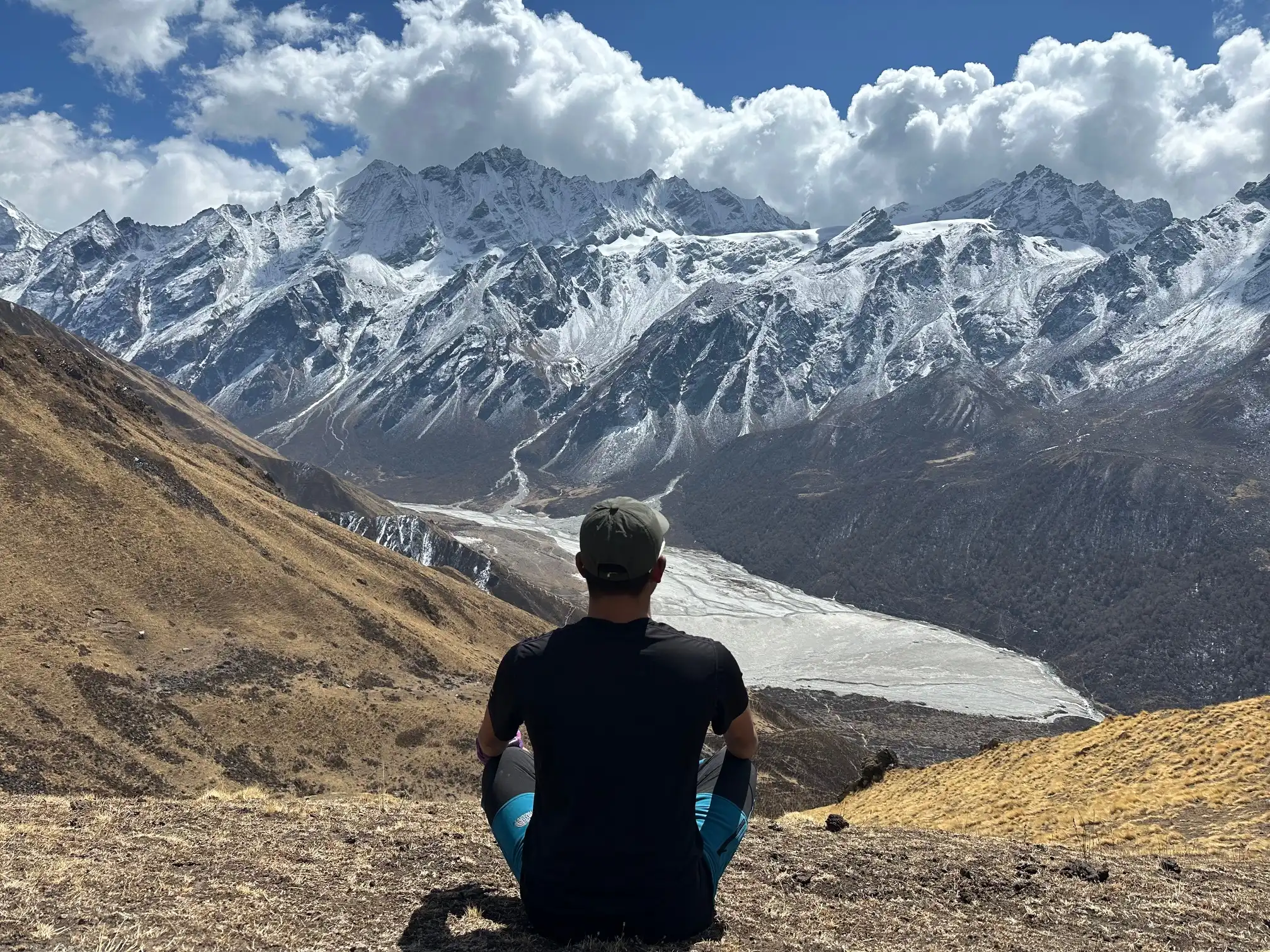
View of Langtang mountain on the way to Tserko Ri
Top 5 Reasons to choose Langtang Valley Trekking allows travelers much awareness before planning the wonderful trek to Kyanjin Gompa.
One of the best short moderate adventures where all types of travelers can join in to enjoy the stunning scenery. A scenic and cultural country walk are perfect for family, school, and college groups, as well as for a corporate executive.
Langtang Valley offers more than one can expect, from beautiful views of towering snow-capped peaks to local immense cultures.
A great way to enjoy a weeklong holiday in the harmony of the refreshingly cool mountain air of Langtang Himalayas.
Top 5 Reasons to Choose Langtang Valley Trekking:
01: The Closest Mountain Region And Nepal First National Park:
The closest mountainous region from the capital Kathmandu, overland journey of approx. 5 hours to the starting point of the trek.
The drive covers a distance of 137 km / 85 miles via Pasang Lhamo Highway through scenic areas of Nuwakott hills. The road follows interesting villages and towns of Trisuli Bazaar, Mane-Bhanjyang to Dhunche town, and the headquarters of Rasuwa district.
Dhunche town, where the main entrance of Langtang National Park starts, is the first mountainous Himalayan Park in Nepal.
Established in 1976 treasures exotic flora and fauna with beautiful mountain ranges and scenic valleys. Includes an enchanting forest of lovely rhododendron, magnolia, pines, and oaks with bamboo; as well as a habitat for various mammals and bird life. The Langtang National Park is also famous for the endangered and rare Red Panda and other mountain wildlife.
02: Short And Moderate Adventure Of A Week Or More:
Top 5 Reasons to choose Langtang Valley Trekking, Langtang Valley is a short and beautiful trek, where trekkers can enjoy diverse landscape views of awesome scenery of high snow peaks.
The trail is well-defined having few high suspension bridges to cross over Langtang glacial river. An amazing trekking route that follows the river upstream close to its glacial source at scenic Langtang Valley.
The walk leads amidst a beautiful dense forest of tall rhododendron, pine, and hemlock trees through lovely settlements. The trail leads into a river gorge and then reaches into a wide picturesque valley enclosed by towering gigantic peaks.
As the trek progresses leaving the tall tree lines behind for short alpine bushes entering the Langtang Valley. Where Kyanjin Gompa is located surrounded by rolling rocky hills and arrays of snow-capped peaks.
An enjoyable walk from the start to the end of this wonderful adventure. Although a high hill trail, one can enjoy taking a slow pace and having refreshing rest. As well as overlooking the surrounding scenic views of Snow Mountains and picturesque terrain, with ample time to explore the villages.
03: Safe Walking Without A Problem Of High Altitude Sickness:
Top 5 Reasons to choose Langtang Valley Trekking, Langtang valley where walks lead you to the heart of the Central Himalayas within the great Langtang Himal range. Reaching the final destination at Langtang Valley the highlight of the adventure, where Kyanjin Gompa is located at 3,870 meters.
Starting from Syabrubesi village at 1,440 m with a slow gradual climb to Lama Hotel at 2,560 m high. A rise of 1, 120 m within an average distance walks of 5-6 hours. Having enough time for short refreshing rest and lunch breaks in between, allows trekkers to get acclimatized.
The walk continues higher above Langtang village at 3,430 m taking a normal leisure pace. As altitude gains gradually and staying overnights at certain heights makes, the trekkers more comfortable for next-day walks.
Then finally reaching the main goal and highlight of the adventure at Kyanjin Gompa at 3,870 m high. After covering more than 32 k.m. or 20 miles in sound physical health. After enjoying a good rest day to explore its best viewpoints, walk down to Syabrubesi village.
Langtang Valley Trek
04: Beautiful Places To Explore Around Langtang Valley:
Top 5 Reasons to choose Langtang Valley Trekking, Langtang Valley while staying at a lovely cozy lodge at Kyanjin enjoying good foods, and various places to explore. Energetic and interested trekkers can climb to Kyanjin-Ri at 4,775 m & Tserko-Ri at 4,984 m for spectacular mountain views.
Visit the Yak Cheese factory at Kyanjin Gompa and the traditional Tamang villages adorned with the age-old heritage culture of Buddhism.
Langtang Valley is also the best and perfect place for acclimatization for trekkers, who are heading toward higher destinations. From Langtang valley onwards trekkers can continue crossing the high Ganja-La pass to Helambu.
Most trekkers extend their walks by combining the adventure with the high and holy Gosainkunda glacial lake. As well as crossing the high pass over Gosainkunda-La to reach Helambu and the eastern rim of Kathmandu valley.
05: Langtang Valley For All Seasons:
One of the few treks around Nepal Himalayas where one can enjoy the adventure almost all year round. Except the monsoon wet months, during the heavy rainy season of mid-June to August months.
The best time is spring and autumn/fall; where most days are bright full of sunshine and clear for views and walks.
Springtime, when hills and valleys are lively with wildflowers in full bloom, especially the rhododendron of different colors.
Autumn/fall from September to November one of the best season for pleasant walks and enjoying dramatic views. Interested people can also trek during the winter time of Christmas and New Year Holidays, although much cold morning and night time. But most days are fine and clear but shorter sunlight hours, chances of snowfall sometimes.
EBC trek important information Since the conquest of Mt. Everest by legendary mountaineers Tenzing and Hillary on May 29th, 1953. From then onwards, the Everest Camp trek and the high Khumbu region became one of the most popular adventure destinations.
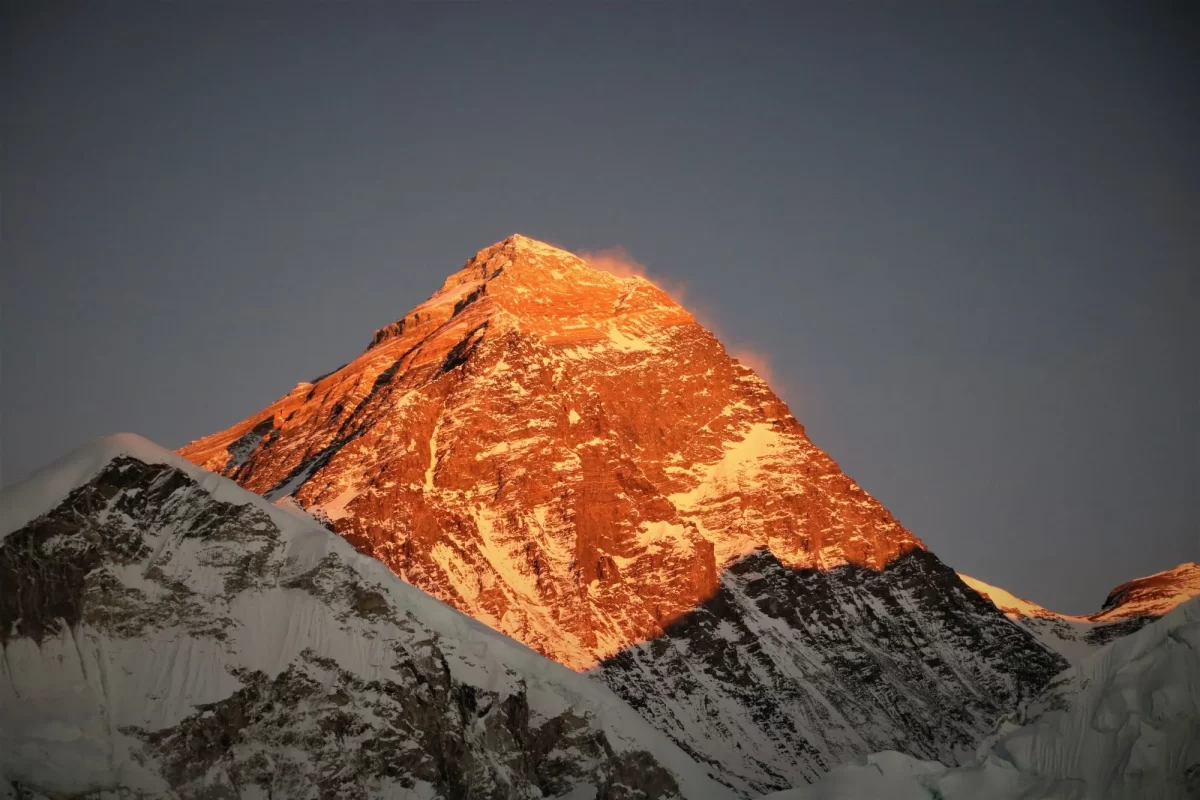
On the way to EBC
In the past few decades, the main flow of trekkers has increased with thousands of visitors to Everest base camp. The region around high Khumbu and Everest has turned into one of the favorable regions for exciting treks. Where worldwide travelers can enjoy wonderful high-altitude walks in the harmony of sheer mountain wilderness with impressive cultures.
Everest base camp, where all can have enjoyable adventure holidays, following the tips provided by Vertex Treks & Expeditions. Most trekkers might be unaware, of where and how to reach Nepal for the Everest base camp trek.
As well as in search of information to make the dream come true reaching close to the world’s highest Mt. Everest.
An ever-exciting adventure of a lifetime to experience walking around high scenic trails to Everest base camp. Everest base camp trekking, where all types of travelers and age groups can join on this spectacular adventure. Enjoying the gorgeous mountain scenery in the comfort of a nice cozy lodge and the warm hospitality of the native Sherpas.
01: Useful Tips for Everest Base Camp Trek:
Staying healthy and physically fit.
Book with the right and reliable local or overseas trekking agencies.
Make sure the company is registered with Nepal Government’s respective Tourism Department.
Get information about the trek departure dates.
Check the date of departure that fits with your holiday from work.
Search the website to choose the company of your interest and choice.
On booking acquire much information regarding the trip.
Purchase the trekking gear required according to the season wise.
Understand the nature of trekking and the group size to join.
Get to know about the trip cost with includes and excludes.
02: How to stay fit before and after booking Everest Base Camp Trek:
Know about the terrain and trails including the altitude of the trek.
Practice some light exercise few hours of walks ups and downhill.
Jogging, swimming, aerobics, and Zumba or Yoga exercise.
Check with your family doctor regarding AMS symptoms (Acute Mountain Sickness) or other common sicknesses.
Know about your past medical history to be aware of.
Check which food is right and best for you to keep fit.
Get information on what types of food and meals are available on trekking.
Inquire regarding the local hospitals and health posts available on treks.
Be prepared for the standard itinerary that suits your time in Nepal.
In case of server sickness and accidents, what are the means to get back?
03: Packing and buying the right gear for the trek:
Make sure your passport does not expire within 6 months of travel.
Legal passports and carry at least 6-8 PP. size photos if required.
Carry all necessary documents required for the treks.
Purchase Travel & Medical Insurance it’s a must and important.
Know the shortest air route to Kathmandu, when buying airline tickets.
Get the right clothing and trekking gear required seasonal-wise.
Make sure that sleeping bags and duffel bags are provided by the local agents.
Buy perfect-fitting trekking boots that can withstand rain and snow.
Inquire about the things that can be bought in Kathmandu for the trek including trekking maps of the area.
Get the visa from your own country from Nepal Embassy or Consulate if not available. On arrival at Kathmandu international airport can obtain the visa.
Carry US$, Euro, Sterling Pounds, or any other foreign convertible currency in cash also to get a visa from the airport. As well as to pay the remaining balance to local agents or by credit card, where a 5 % surcharge is added.
Get to know the location and standard of hotels in Kathmandu.
04: Things To Know About Local Culture And Trekking Routes:
The Khumbu region of Everest is populated by the Buddhism religion and culture.
Respect the local heritage and culture.
On trekking or traveling anywhere take care of local ecology.
Follow the rules as maintained by the local villagers.
Ask your guide or village person when taking photos of people or inside the monasteries.
Maintaining hygiene and taking care of litter and the fragile environment.
Be happy and show your right positive attitude to enjoy the holiday.
05: Trekking Routes, Trails & Village Including Local Lodge:
Using hot showers and re-charging electronically ask the price first.
Maintain the rules and customs of the villages and lodges on the route.
Never bargain on food and accommodation except buying souvenirs.
Check the food menu and order as per your delight.
Always be thankful to the villagers and lodge owners depending upon the services.
Use only boiled filtered water for drinking and ask for the price per liter.
Interacting with locals feel safe and enjoy their culture and custom.
Make sure what types of transportation are provided for the drive start of the trek and at the end.
Staying Healthy And Physically Fit As Well As Being Aware Of The Trekking With Full Information:
01: Useful Tips for Everest base camp Trek:
Always best to make yourself fit and healthy to enjoy the rest of your life as well for the trek in the Himalayas.
(a) First and important is staying fit and sound, and healthy to cope with the Himalayan high-altitude terrain.
Being fit and in good health physically then search for the best local agents in Kathmandu, Nepal. For instance, Vertex Treks & Expeditions is a company known for reliable and best services and affordable prices.
All reliable local companies to choose from should be recognized by the Government of Nepal Tourism Department, as well as by TAAN. (Trekking Agents Association of Nepal). Including trekking guides holding government approved with licensed to guide.
(b) Check the date of departure that fits with your holiday from work.
Get information about the trek departure dates. Make sure that you have picked the right dates and itineraries as per your holiday duration for the trek.
(c): Search the website to choose the company of your interest and choice.
Before booking the trip of your interest and choice surf the websites to find the right local company in Nepal. As well as the standard of the services that provide according to the trip price, checking the dates for trek departures. If not joining with the group inquire if it’s possible to join the trek as an individual or solo.
(d): On booking acquire a lot of information regarding the trip.
Before booking the trip get to know much of the trek itineraries, with all information and details related to the Everest base camp trek.
Being aware nature of the trekking trails, and altitude with safety measures required for the trek. As well as information on the guide to lead the trek, and how safe and responsible the company can take care of.
(e): Purchase of the trekking gear required according to the season wise.
Making sure of the trekking list and items to buy from home before the trek departure and flying to Kathmandu. Inquire if it’s too much to carry from home, and ask if it can be bought or hired in Kathmandu.
(f): Understand the nature of trekking and the group size to join.
It is important to know the trail condition and route of the treks, as well as the number of trekkers in the group. Making sure the nationality of each person joins makes the trek more enjoyable knowing the members for the trip.
(g): Get to know about the trip cost with includes and excludes.
After paying much of the trip cost, must be fully aware of what’s included and excluded in the trip cost. So that they won’t be any misunderstanding between you and the company. If in doubt there is always time to discuss with the respective companies if something is missing in the trip cost. Must declare before the trek departures, as the guide only follows the rules of the company.
As well as guiding the trekkers safely and soundly offering information on the respective areas of trekking.
02: Staying Fit For Everest Base Camp Trek:
A physically fit person can enjoy the best of holidays, as well as being healthy and wise taking the right types of food to stay fit.
(a): Know about the terrain and trails including the altitude of the trek.
Staying fit will be a great advantage to enjoy the whole trekking. As well as to rejoice in the harmony of local cultures and scenic views. The first thing is to know the trail conditions how steep up to climb and for the descent is. As well as how much altitude to gain every day before reaching the overnight stop.
(b): Practice some light exercise few hours of walks ups and downhill.
A simple exercise will be great to start with a walk of a few hours walking or running ups and downhill. But do not overdo it to make yourself tired and breathless, take it easy at a normal safe pace and get advice from the concerned agents or medical experts.
(c): Jogging, swimming, aerobics, and Zumba or Yoga exercises.
A short Jogging around your hometown or in the park, daily an hour jog in the morning or late afternoon. Besides jogging exercises, swimming aerobics or Zumba are best to keep yourself fit and healthy, including some Yoga practice for breathing and leg and lung exercise.
(d): Check with your family doctor regarding AMS symptoms (Acute Mountain Sickness) or other common sicknesses.
Before and after booking the trip, get a medical checkup even though you are fit and able. But altitude sickness or AMS can occur to any fit person at anytime if one is not careful. Where your doctors or friends who have trekked in the Himalayas will help you with information regarding the AMS. The company that you have booked will also provide information and details of altitude sickness symptoms and how to take precautionary measures.
(f): Know about your past medical history to be aware of.
Most people being busy at work might be unaware of some hidden medical problem that you do not realize. If some people have done some minor or major operation or surgery and taking pills as per the medical advice. Better to know your past illness so that on treks the old symptoms won’t occur, and your guide and leaders should know also about your medical history. So that they can take extra attention and care for you if needed.
(g): Check which food is right and best for you to keep fit.
One of the most important is your diet, and what you consume and eat most as at present more western people are vegetarian. Having a special diet or are allergic to some foods, let the company know beforehand then the guide will provide you with the food of your choice during the trek.
(h): Get information on what types of food, and meals are available on trekking.
It is better to know and be aware of what types of food are served on route trekking on overnight and lunch stops. Most standard lodges around bigger villages and settlements serve a full comprehensive food menu.
From Continental, Indian, Chinese, Nepali, and Tibetans some places also serve Italian, Mexican, Japanese, or Korean cuisine. Including fresh bakeries’ products as well. Order according to the menu where most foods are cooked hygienic, some smaller villages have a basic lodge, which provides simple meals but good especially the Nepalese famous Dal Bhat, or noodles and Tibetan bread or Chapattis, unleavened bread.
(i): Inquire regarding the local hospitals and health posts available on treks.
Best to know about medical facilities available on route treks around the main villages, and what precautionary measures are taken by the local company or guides. As accidents and unfortunate incidents can happen anywhere and at any time.
(j): Be prepared for the standard itinerary that suits your time in Nepal.
Always know the full itinerary details, about precautions, and the route of trekking and places for overnight stops. Regarding the local culture and custom as well the itinerary have enough days for acclimatization and exploring the local villages. As well the itinerary suits you your international flight schedule and the duration of your holidays for the trek.
(k) In case of server sickness and accidents what are the means to get back?
One of the most important is knowing, what means of transportation are available on route trekking. If someone has to return home earlier breaking the trip halfway, due to a personal problem. As well as if someone gets very sick or gets wounded by unfortunate accidents. Right to know the types of fastest transport for emergency evacuation, which will be walking back to a road-head getting on local vehicles, or using the helicopter services. This is why you’re medical and travel insurance comes in handy and important to claim the cost incurred by sudden illness or accidents.
03: Packing & Buying The Right Gear For The Trek:
Packing and buying the right kinds of equipment and clothing will make it worth trekking, as well as carrying the needful documents and papers required for Nepal and trekking.
(a) Make sure your passport does not expire within 6 months of travel.
The first thing is to check your main ID and the passport, which should not exceed the expiry dates minimum of 6 months. For dual citizen passports, use only one country passport. It will create problems in acquiring Nepal visas and necessary trekking permits.
(b) Legal passports and carry at least 6-8 PP. size photos if required.
Make sure to carry a passport with dates that do not expire within 6 months of traveling overseas. Carry at least 6-8 recent passport-size photos, required to obtain the Nepal visa as well as trekking permits.
(c) Carry all necessary documents required for the treks.
Check that you have all the necessary documents required for the treks and travel when leaving your home country.
(d) Purchase Travel & Medical Insurance it’s a must and important.
Most important getting the best Travel & Medical Insurance should cover all medical bills incurred. Including expenses on emergency evacuation by various means of transportation from private vehicles to Helicopter services if required.
(e) Packing and buying the right gear for the trek:
The other important is buying the right types of trekking gear as per the list provided by Vertex Holiday. At present most of the trekking gear can be hired or can be bought in Kathmandu as well. If it’s too much to carry from home at a reasonable price.
(f) Know the shortest air route to Kathmandu, when buying airline tickets.
To make it easier find the airlines with the cheapest and best shortest route to Kathmandu from your home country. Normally transit is mostly in Middle East countries when traveling from Europe for the flight to land at Kathmandu-Nepal international airport.
(g) Get the right clothing and trekking gear required seasonal-wise.
When buying warm and light clothing season-wise, where spring is quite warm till mid-afternoon. But be prepared for the cold climate in the morning and nighttime with the extra wind-chill factor.
(h) Make sure that sleeping bags and duffel bags are provided by the local agents.
Important to know if sleeping bags and duffel is included in the trip cost. If not one can bring four-season sleeping bags with inner linear, necessary to use sleeping bags of your own. Even though spending overnights in the comfort of a nice local lodge. Duffel or kit bags, are best to have semi-waterproof, one can buy them in Kathmandu as well of good quality.
(i) Buy perfect-fitting trekking boots that can withstand rain and snow.
EBC trek important information, The first important thing when buying trekking gear is trekking boots, buy a little larger. So that it can fit with the thick socks required in the cold mountain terrains. As well as a few ‘centimeters of space for the movement of your toes from the cold freezing temperatures. The boot to buy that is snow or water-proof, if not carry a wax to put on boots in snow-rain conditions.
(j) Inquire about the things that can be bought in Kathmandu for the trek including trekking maps of the area.
Besides normal gear to bring from home, due to flight weight allowance. If it’s too much to carry. Where most items required for trekking are available in the stores and shops in Kathmandu as per your choice of brands. Make sure with your booking agents the things that can be bought in Kathmandu.
(k) Get the visa from your own country from Nepal Embassy or Consulate if not available. On arrival at Kathmandu international airport can obtain the visa.
On booking with Vertex Holiday, obtain the Nepal entry visa for the number of days or more required for the Everest base camp trek.
Can get a visa from your home country through Nepalese Embassies and Consulates. If not, can get on arrival at Kathmandu and Nepal International Airport at the Immigration Desk.
(l) Make sure to carry extra cash and photos required for the visa on arrival at Kathmandu airport.
Carry US$, Euro, Sterling Pounds, or any other foreign convertible currency in cash also to get a visa from the airport. As well as to pay the remaining balance to local agents or by credit card, where a 5 % surcharge is added.
On paying the advance trip cost to the local agents in Kathmandu, the rest of the remaining trek payment can be paid on arrival, before the trek departures.
All balances should be made in cash with convertible foreign currencies like US$ or Euro, if not can pay with an applicable Credit Card. On Credit Cards, 3-5 % extra is added as a surcharge on top of the main remaining trip cost.
(j) Get to know the location and standard of hotels in Kathmandu.
It is always best to know about the hotel location in Kathmandu. Although the company provides transportation with representatives, staff, or guides to pick up the guest on arrival. But sometimes the international connecting flight can get delayed without notice. You might land in Kathmandu on short notice in this situation it will be good to know the hotel and its location. So, you can take a taxi to the hotel where your room will be at your disposal.
(k) Know the shortest air route to Kathmandu, when buying airline tickets.
When booking for the trek first make sure which airline is the best to connect flight to Kathmandu. Cheap and the best that can reach and land in Kathmandu a few days ahead before the trek departure dates. As well for flying back home on time taking the best shortest and easy route.
04: Things To Know About Local Cultures And Trekking Routes:
It’s always good and best to be aware of the local cultures of Nepal, as well as the Everest base camp trek. As there are certain restrictions like the mode of dress code and respect entering monasteries and shrines.
(a): The Khumbu of Everest is populated by Buddhism religion and culture.
The whole Khumbu of Everest region is dominated by Buddhism religions and impressive cultures of age-old heritage.
(b): Respect the local heritage and culture.
Always follow the guide’s advice of do’s and don’ts walking around villages with shrines and religious monuments. Walking through villages from Jagat with more Buddhism, encountering rows of prayer walls and spinning bells. Walking clockwise of the Mani-Prayer walls and monuments is a sign of respect following the local culture and customs.
(c): On trekking or traveling anywhere take care of local ecology.
All trekkers should follow the norms as Responsible Travelers, taking of pristine nature. Always walking on the right path, and not disturbing the ecosystems and wildlife, respecting the local culture and customs.
Not picking flowers or herbs without the advice and permission of the local villagers.
(d): Follow the rules as maintained by the local villagers.
The villagers on the route are cheerful and friendly like in all parts of Nepal Himalaya region. Welcomes visitors with warm smiles and is humble and polite but does not take for granted doing wrong with a negative act of attitude. Where the trails and lodges foods, and rooms are well maintained by the village communities.
Where you can interact and know the depth of local cultures and customs and rules maintained by the villagers for visitors.
(e): Ask your guide or village person when taking photos of people or inside the monasteries.
Never take a snap or photos of elderly people and families without permission from the concerned person. Your guide will advise regarding taking photos of a person, as well as visiting the monasteries’ interior. Some monasteries may charge some fee or donations for taking photos inside. As well as the present monks and priests.
(f): Maintain hygiene and take care of litter and the fragile environment.
Everest region of Khumbu from Monjo village entering the Sagarmatha National Park. Where strict rules are maintained by the park authorities and SPCC (Sagarmatha Pollution Control Committee).
The guide on treks as well as trekkers should use the designated dumping or disposal site for rubbish and litter, especially around the villages. If not carry it with you till a proper disposal site is found on route trekking.
(g): Be happy and show your right positive attitude to enjoy the holiday.
Feel happy and show gratitude and the right attitude while exploring the villages and monasteries. Have time to chat and interact with the cheerful locals, enjoy having refreshments, and learn more about the local impressive cultures and customs.
05: Trekking Routes, Trails & Village Including Local Lodge:
EBC trek important information, The trekking route on Everest and Khumbu region are well defined and straightforward. No confusion just follow the guide’s advice the guide and maps on daily walks to Everest base camp.
(a): Using hot showers and re-charging electronically ask the price first.
Every lodge and tea house on the route are well equipped with hydroelectricity or solar power. Where visitors can re-charge their electronic items and gadgets, paying a fee for every hour per item used for charging. To enjoy hot showers or buckets of warm water to refresh oneself needs to pay some amount. Better know the price first before taking a shower and a bath from the respective lodges and inns.
(b): Never bargain on food and accommodation except for buying souvenirs.
While staying in lodges on route trekking, where all food and accommodation are included on the trip cost. However, some trekkers might order extra foods and snacks, where all prices are fixed as recommended by the village committees. So, there is no issue of bargaining the price, except if you are buying local souvenirs. You can bargain sometimes slightly for a lower price if interested in the items you intend to buy.
(c): Check the food menu and order as per your delights.
In groups of more than 4-6 and above, a set of meals will be served of various types of items. Set meals for groups saves time and fuel energy as well as makes it much better to serve the landlords. For vegetarian and special dietary needs to inform the company and guides beforehand.
(d): Always be thankful to the villagers and lodge owners depending upon the services.
Most meals served on lodges are hygienic, good and nutritious, and healthy from continental, Chinese, Indian, and Tibetans or Nepali.
Be thankful and show kind gratitude that will encourage the local chef or lodge owners to serve better and keep the standard and qualities.
(e): Use only boiled filtered water for drinking and ask the price as per liter.
On trekking, the best is to use boiled and filtered for drinking and taking caution as water is the main reason for sickness. We do not encourage bottled water due to eco-trekking commitment, as plastic bottle creates garbage unless it is recycled. Few places have water filling stations which cost much cheaper than the lodge. Check it with your guide, all safe water needs to pay as per liter wise.
(f): Interacting with locals feeling safe and enjoying their culture and custom.
One of the best ways of traveling to foreign countries especially the Himalayan areas of Nepal. Trekkers will be amazed and surprised by the friendliness and hospitality of Nepalese people. A good way of understanding the local simple farm life and interacting with the friendly villagers on route trekking.
Makes a wonderful way to enjoy the adventure on the Everest base camp trek or all around the Himalayas.
(g): Make sure what types of transportation are provided for the trek and at the end.
Everest base camp starts with a short flight to Lukla, from Kathmandu or Manthali town airport of Ramechap district. If flying from Manthali airport a private vehicle takes you to Ramechap at Manthali airport a day ahead to catch the flight to Lukla. Same way on the way back to Kathmandu, flying to Manthali and driving to Kathmandu.
The Top Ten Things to Do in Nepal, one can enjoy various exciting activities in the backdrop of the high Himalayas’. Nepal is a country for all types of adventure sports, from trekking, and peak climbing to major mountaineering expeditions.
Stupa during the EBC Trek
Nepal is blessed with natural wonders with the world’s highest peaks, beautiful glacial lakes, and dramatically varied landscapes. Nepal for all seasons, choosing varied different holiday destinations, from deep dense green jungles of Chitwan to cooler scenic hills. Extending towards an arctic zone of ice and glaciers reaching the base of the world’s highest Mt. Everest.
Nepal is a country with the least metropolitan cities that offers little nightlife around tourist places like Kathmandu and Pokhara. Visitors can enjoy some of its nightclubs, pubs, and casinos; but the major holiday places are around the high Himalayas.
01: Things to Do in Nepal Tour Of World Heritage Sites
Nepal is an ancient country, as well as a major hub for Hindu and Buddhist pilgrims and worshippers. Most areas of the country have important religious and historical sites with old holy temples, Stupas, and monasteries.
Kathmandu valley with three main cities Kathmandu, Patan / Lalitpur, and Bhaktapur, although changes in urbanization have grown to modernization. These three beautiful cities retain their old-time glory of ancient temples, monasteries, Stupas, and royal palaces with magnificent courtyards.
Most of the charm and beauty of Kathmandu, Patan, and Bhaktapur are old palace courtyards and religious monuments. All these places are listed as UNESCO World Heritage Sites. A great interesting place to visit is the old-age culture of Nepal and the Nepalese people. Apart from these beautiful cities, visitors can travel to Lumbini around Far Mid-West Nepal, the site where Lord Buddha was born.
02: Things to Do in Nepal Hiking The Scenic Cooler Hills
Visitors before or after major trips around Nepal can enjoy themselves for a day or more. Hiking the cooler scenic foothills with the backdrop of spectacular Himalayan peaks a day hike to Nagarkot Hill station.
Around Kathmandu, Bhaktapur, and Patan / Lalitpur cities offer scenic day hikes to the highest hills of the Kathmandu valley rim. Likewise, Nagarkot, Chisapani, Dhulikhel, and Shivapuri Hills as well as the top of Phulchowki hill, provide nice country day walks. Hiking to scenic spots amidst a beautiful forest of pines and rhododendron trees; enjoy bird-watching along with a wonderful panorama of Himalayan peaks.
03:Things to Do in Nepal Trekking Foothills Or Base Of The Himalayas
The major flow and influx of tourism in Nepal are for trekking, the country offers a wide range of adventure destinations. Interested people can join in for a scenic and cultural trek around the foothills. As well as around the high ridges of Nepal Himalayas to Everest or Annapurna base camps.
Nepal is one of the most popular adventure destinations, with various exciting and scenic places to choose from. Moderate, adventurous to challenging treks of a few days to a week or more to a month duration.
The most popular trekking region is Annapurna, Everest, Langtang, and Manaslu areas, including Far West to Eastern Himalayas. Most trekking spend overnights in a nice cozy lodge or tented camps on off-the-beaten trails.
04: Things to Do in Nepal Climbing Trekking Peaks
Trekking peak climbs is gaining popularity after major trekking around Nepal Himalayas, from above 5,500 m to 6,500 m high. The country with high Himalayan Mountains with a wide range of lesser peaks to enjoy the exciting climb on trekking peaks.
05: Things to Do in Nepal Major Mountaineering Expedition
Besides trekking and interesting tour of world heritage sites, which the country has to offer. Mountaineering Expeditions is another great thrill and one of the major flow of tourism in Nepal. Mountaineering in Nepal started in the early time before the first conquest of Mt. Everest and Mt. Annapurna. Including other 8,000 m famous peaks like Lhotse, Makalu, Cho-Oyu, Dhaulagiri, and Manaslu. All the world’s highest peaks are located in Nepal attracting thousands of mountaineers from around the globe.
Mountaineering in Nepal started in the early 1950s and still growing strong for the great thrill and challenge of mountaineering sports.
06: Jungle Safari In Various Terai National Parks
Nepal is an amazing country, where one can explore from cooler green hills to the mountainous zone and towards the low Terai belt. Visitors can enjoy the great thrill of Jungle and Wild-Life Safari in the dense sub-tropical jungle of Nepal’s lowland.
Deep green jungles located on the Terai belt, are a perfect habitation for endangered mammals. Like Royal Bengal Tiger and one-horned Rhinoceros with other wild animals and exotic bird life. Nepal offers a great exciting safari in the jungles of Chitwan and Bardiya National Parks. Including the Koshi Tappu Wild-Life Reserve situated in far southeastern Nepal. Enjoy the wildlife safari for a few days to a week in the comfort of lovely jungle lodges and resorts.
07: Things to Do in Nepal Mountain Biking Around The Back Trails
Another exciting outdoor activity is Mountain Biking on the back trails, away from main roads, cities, and towns. A great way to enjoy a day or more to a week cycling the hilly single or double tracks.
Mountain biking is a great way to explore the rural farm life of the Nepalese and gain an in-depth into local cultures.
08: Things to Do in Nepal Rafting The Himalayan Glacial Rivers
After trekking and mountaineering, rafting the Himalayan glacial rivers is another great way to enjoy your holidays in Nepal.
The country with high Himalayan peaks feeds the rivers from its glacial source, making it one of the world’s best rivers for rafting.
Nepal offers various Himalayan rivers from the Far East to the western region. The most popular are Trisuli, Seti, Sun Koshi, and Kali Gandaki Rivers for rafting from smooth float to adventurous thrills. Visitors can enjoy a day of rafting or more to a week of paddling downstream through exciting bouncy waves and rapids.
09: Things to Do in Nepal Enjoy Short Adventure Sports (Bungee, Para-Gliding, Ultra Lights, Zip- Line)
While in Nepal on completing or before your major treks and tours, one can enjoy the exciting thrill of adventure sports. Kathmandu and scenic Pokhara city offer a wide range of leisure to adrenaline adventure sports.
The most famous, and popular in Pokhara is Para-Gliding, an exciting glide in the Himalayan blue sky within the shadow of Annapurna Himalayas. The other activity one can enjoy is Bungee Jumping, a few hour’s drive from Kathmandu to reach the Bungee Jumping. The first Bungee Jumping in Nepal, after getting equipped with safety gear.
Then take a deep breath and listen to the commanding loud voice with the word JUMP! Experience, free falls a drop of 160 m / 500 feet towards Bhote Koshi River gorge, one of the world’s longest Jump.
The other place for exciting Bungee Jumping is Kusma town, a few hour drive of 60 km. distance from Pokhara. The Bungee Jumping is listed as the world’s second-highest Jump of Kusma; from 228 m / 749 feet high. After a safe and enjoyable jump, drive back to Pokhara.
While in Pokhara or Kathmandu enjoy joining in for the fastest speed on a Zip-line provides an exhilarating experience. The other exciting thing to do is take a flight on an Ultra Flight. A small single-engine aircraft a flight of less than an hour facing panoramic views of the Annapurna Himalaya range.
10:Things to Do in Nepal Relaxing Holiday In The Hill Stations Of Nepal Himalayas
After enjoying major trips in Nepal Himalayas, with more time to enjoy the beautiful landscape scenery of Nepal. Enjoyable relaxing spots are the scenic hills of Nagarkot and Dhulikhel for leisure holidays. Enjoy the stunning sunrise and sunsets along with the magnificent panorama of Himalayan peaks as far as Everest. The Hill stations of Nagarkot or Dhulikhel offers great relaxation in the comfort of international standard deluxe hotel and resorts.
Annapurna base camp versus Annapurna Circuit trek, is an interesting subject and topic, to understand between these wonderful adventure treks.
Although, the massif Annapurna Himalayan range of peaks is the same for both exciting places to trek. The only difference is the high altitude, vegetation, landscapes, climate, and local cultures where trekkers can feel the contrast.
As well as the length of the journey and duration of walks, the comfort of accommodation, food, and scenery. The variations are quite different on these both beautiful destinations to choose from, Annapurna base camp and Annapurna Circuit treks.
Annapurna Base Camp and Annapurna Circuit Trek, are both exciting and worth a visit to experience. Depending upon one interest and holiday duration in Nepal, including physical fitness and health-wise.
Both trekking destinations require the same types of Trekking Permits TIMS (Trekking Information Management Systems); and ACAP entry fees (Annapurna Conservation Area Project).
Both areas are great Himalayan destinations to enjoy, choosing the full circuit or taking a short route to Annapurna base camp.
The other important things to know before choosing between Annapurna Base Camp and Annapurna Circuit Trek are. Is being of the best seasons of the year, where Annapurna base camp can trek nearly all seasons. As for Annapurna Circuit due to its high altitude landscapes and crossing Thorang-La Pass; needs the right time of the seasons.
Annapurna base camp versus Annapurna Circuit trek., Annapurna base camp trek is a short and scenic country walk that does not involves high passes. The only highest spot is the Annapurna Base Camp at 4,130 m 13, 550 feet, located within the picturesque Annapurna Sanctuary.
Annapurna base camp trek leads you to the heart of the massif Annapurna Himalayas surround by towering snow-capped peaks. Facing views most of the Annapurna range of peaks from number one Annapurna-I, III with Annapurna South, Huin-Chuli, Annapurna Fang / Vara Shikar. Mt. Annapurna-I at 8,091 m / 26,545 feet, stands as the world’s 10th highest peak. The first 8,000 m mountain ever climbed in the history of mountaineering, summited by French Expeditions in the 1950s. Which was three years ahead of Mt. Everest was conquered in 1953 by Tenzing & Hillary.
The Annapurna Base Camp Trek, where trekkers can enjoy taking various routes to the last permanent village of Chomrong. Where all trail joins en route to Annapurna base camp and the sanctuary, enclosed within a series of snow peaks.
One can take the shortest route of a week to Annapurna base camp and back to scenic Pokhara city. The starting and ending point of the Annapurna base camp and various other destinations around the Annapurna Himalaya region.
People with more time can extend the duration of trekking including Ghorepani and Poon Hill. Then join on the main trail to Annapurna Base Camp at Chomrong village, the center point of the trek. Where trek leads through Chomrong village as well on the way back to the end of walks at Jhinu village.
On the Annapurna Base Camp trek, can enjoy a walk amidst a lovely forest of rhododendron and pine trees. Then the walk leads above the tree lines towards remorseless fields of ice, snow, and glaciers at Annapurna Base Camp.
Annapurna Base Camp is an adventure for all types of travelers and age groups, where altitude gains slowly and gradually. Without the problem and hassle of getting High Altitude Sickness or AMS (Acute Mountain Sickness).
The only Base Camp in the whole Himalayas ranges with the comfort of nice and cozy Tea-Houses and Lodges. Annapurna base camp can be visited nearly all year round except the wet rainy season of monsoon time.
Best in spring March to May and autumn/fall from September to November months are the high seasons.
Annapurna base camp versus Annapurna Circuit trek, Annapurna Circuit Trekking, listed as world’s top ten best adventure destinations which you can experience, joining on this marvelous walk.
At present due to the construction of motorable dirt road; the trekking days are much shorter than it was in the past decades. However, Annapurna Circuit remains the best wonderful trekking adventure around the Himalayas. The walk involves a variety of landscapes, vegetation, and cultures as the trail follows slowly to higher terrains.
Annapurna Circuit trek can be done both ways anti-clockwise or clockwise, but the most popular route; is the anti-clockwise direction.
Annapurna base camp versus Annapurna Circuit trek, Trekkers have options to choose to start the trek from the low Syange village at 1,200 m or Dharapani at 1,860 m high. After taking a long drive from Kathmandu or Pokhara, whatever the start of a trek is chosen. Eventually, it leads you to the lovely town of Chame and Pisang village, then reaches the scenic Manang valley.
The whole picturesque valley is surrounded by giant peaks of the Annapurna Himalayas and a group of Chulu peaks with a lofty Pisang peak. The adventure continues reaching at main Manang village at the height of 3,519 m or 11,545 feet high.
Annapurna base camp versus Annapurna Circuit trek, A breathtaking spot with tremendous views of the Snow Mountains at a near distance, a perfect place for a rest day.
As well for acclimatization in the comfort of nice lovely lodges and guest houses with rooms facing grand mountain scenery. A great place to explore the viewpoints and visit the village adorned with the ancient traditional heritage of Buddhism.
The walk continues heading due west at the end of Manang valley reaching the base of Thorang-La high pass. Next early morning a steep climb to the top of Thorang-La pass, the highest point of the adventure. Thorang-La at 5,416 m / 17,700 feet, festooned with thousands of colorful Buddhist prayer flags.
The top of Thorang-La marks the boundary of Manang and Mustang districts, where the walk follows long descent to Muktinath premises. A holy temple and a famous pilgrimage site for Hindu followers, an interesting place to visit. Reaching Muktinath at 3,710 m, Muktinath is a Sanskrit word that means to be free or liberated from sins or wrongdoing.
From Muktinath with few options to choose to end the trek, either walk to the roadhead on route Pokhara. The other short alternative is taking a drive or a short flight to Pokhara city airport. But most trekkers opt for a few hour’s drives to low warm areas of Tatopani, the village with natural hot springs.
Spending overnight in Tatopani village and enjoying the refreshing warm bath and a dip in the hot spring. The next day, the climb leads to nice farm areas then reaches Ghorepani, a famous village for a hike to Poon Hill. The top of Poon Hill offers stunning sunrise over a 360° wide panorama of Himalayan peaks.
After Ghorepani and Poon Hill a long downhill through beautiful rhododendron and pine forest to low warm paddy fields. Where the Annapurna Circuit trek concludes by taking a short exciting drive to beautiful Pokhara city.
On Annapurna Circuit Trek, interested people can extend a few more days by visiting the world’s highest Tilicho Lake also.
Annapurna Base Camp VS. Everest Base Camp Trek which one to choose? It can be quite confusing and difficult to take the right and perfect options to choose from. As both treks lead in the heart of a towering Himalayan range of peaks and have their beauty and charms.
The only difference between these two giant mountains is the height and location and accessibility to reach the destination.
Annapurna Base Camp Trek against Everest Base Camp, quite a difference even though located in around the same Himalayan range. Where Annapurna Himalayas is situated in the Far North Mid-West and Mt. Everest towards Far North Mid-East Nepal.
Both Mountains are at a distance of 307 km. / 191 miles apart, where Kathmandu is in the center. Between these two world’s highest peaks, can be viewed from both high viewpoints of Kathmandu valley.
The climate, vegetation, people, cultures, and landscapes also differ between the two great regions of Annapurna and Everest Base Camps. However, the trek around these two beautiful leads to an amazing adventure of great life experience.
The other great difference is the duration of walks to the base camps, where Annapurna Base Camp is shorter. Where Everest Base Camp treks take much time and are quite far from the starting point from Kathmandu.
Annapurna Base Camp Trek VS. Everest Base Camp Trek To Choose From:
Annapurna Base Camp:
Annapurna Base Camp Trek is one of the shortest 8,000 m mountain base camps in the whole Himalayan region. One can cover a distance of approx. 110 km. both ways in a week, walking for six hours. Covering an average of 10 km per day to designated overnight stops before reaching the Annapurna Base Camp. On return, the journey can trek more than 15 to 18 km. downhill and lose height every hour.
Annapurna Base Camp trek is moderate to adventurous, without a problem of catching High Altitude Sickness or AMS (Acute Mountain Sickness). Where elevation gains gradually and gets acclimatized as you stop for an overnight stop at certain heights.
Eventually walk leads to the highest spot at Annapurna Base Camp at 4,130 m / 13, 550 feet high. One special about Annapurna Base Camp is the only base camp that has a facility of a nice cozy lodge. Located right beneath the world’s 10th highest Mt. Annapurna-I at 8,091 m / 26,545 feet. Most trekkers are unaware that Mt. Annapurna-1 was the first 8,000 m peaks ever conquered in the history of mountaineering. In the year 1950 before Mt. Everest was climbed by Tenzing and Hillary on May 29th, 1953.
The beauty of the Annapurna base camp trek is the diverse landscapes and climatic conditions. Where the walk leads from low warm sub-tropical to cooler hills and ends at an arctic zone of ice and glaciers. Reaching Annapurna base camp enclosed within massif towering peaks of Annapurna-I and its series of mountain ranges.
The walk also takes you through a beautiful forest of pines, rhododendron, and bamboo grooves. On reaching Annapurna Sanctuary, tree lines disappear for mountainous barren landscapes, enclosed by towering snow-capped peaks.
The walk takes you around the mountain villages of Jhinu and Chomrong inhabited by the Gurung, the main tribes of the Annapurna Himalayas. Follows Buddhism religion as well Bon sect of pre-Buddhism, worship of nature and mountain spirits.
Annapurna Base Camp trek involves a short drive both ways to and from the scenic and renowned tourist city of Pokhara.
Everest Base Camp:
Hiking to Everest Base Camp
Everest base camp trek is a dream adventure for millions of people in the world to stand beneath the world’s highest peak. Mt. Everest is one of the most famous and popular adventure destinations in the Himalayas.
Mt. Everest is about 160 km or 99 miles air distance from the capital Kathmandu, which involves short flights both ways.
The walk to Everest base camp starts and ends in Lukla Town at 2,820 m high. Covering a distance of about 62 km. or 39 miles one way, taking more than 11 days both ways. Including acclimatization days on the way up to Everest base camp and reaching Everest base camp. Which is at a height of above 5,364 m / 17, 598 feet high, Everest base camp is a scenic walk.
On Everest base camp one needs to take care taking things at a slow pace due to the gain in altitude. Where acclimatization days are required as well as walking slowly and having enough short rest to fight against the high altitude symptoms.
A great adventure facing grand views of towering giant peaks on daily walks through lovely Sherpa villages. An interesting trek from Lukla and Namche Bazaar onwards encountering Buddhist monuments, and visiting monasteries of great religious interest. The wonderful walk takes you above the tree lines to scenic valleys to reach the highlight at Everest base camp.
Everest Base Camp also shares the base of Mt. Lhotse world’s 4th highest peak, an arctic type of landscape. Standing beneath the world’s highest Mt. Everest and observing the massif Khumbu Ice-fall and glaciers.
In the high season of mountaineering, the base camp is flooded with tented camps for expeditions from various countries. The Everest base camp will not be complete without the climb of the popular and famous Kalapathar hilltop. Kalapathar is also the highest point of the adventure on the Everest base camp trek. Where trekkers can catch the closest views of Mt. Everest along with a glorious panorama of surrounding giant peaks.
After a great time visiting all the main highlights heading down and short ups to Namche Bazaar. Finally ending the walk in Lukla for a short sweeping flight back to Kathmandu, after an amazing time on Everest Base Camp Trek.
Conclusion Between Annapurna & Everest Base Camps Treks:
Both base camps offer special charm and delightful moments, whereas the Annapurna base camp is short with easier accessibility. Where Everest base camp takes longer days involves flight both ways, the problem is for the Everest base camp trek.
If the weather is unfavorable and bad the flight gets delayed or leads to cancellation for some days. Overall Annapurna and Everest camps treks are worth visiting, offering different types of interest with ever-lasting memories and experiences.